Brood of the witch queen, p.1
BROOD OF THE WITCH QUEEN, page 1


MORE WILDSIDE CLASSICS
Dacobra, or The White Priests of Ahriman, by Harris Burland
The Nabob, by Alphonse Daudet
Out of the Wreck, by Captain A. E. Dingle
The Elm-Tree on the Mall, by Anatole France
The Lance of Kanana, by Harry W. French
Amazon Nights, by Arthur O. Friel
Caught in the Net, by Emile Gaboriau
The Gentle Grafter, by O. Henry
Raffles, by E. W. Hornung
Gates of Empire, by Robert E. Howard
Tom Brown’s School Days, by Thomas Hughes
The Opium Ship, by H. Bedford Jones
The Miracles of Antichrist, by Selma Lagerlof
Arsène Lupin, by Maurice LeBlanc
A Phantom Lover, by Vernon Lee
The Iron Heel, by Jack London
The Witness for the Defence, by A.E.W. Mason
The Spider Strain and Other Tales, by Johnston McCulley
Tales of Thubway Tham, by Johnston McCulley
The Prince of Graustark, by George McCutcheon
Bull-Dog Drummond, by Cyril McNeile
The Moon Pool, by A. Merritt
The Red House Mystery, by A. A. Milne
Blix, by Frank Norris
Wings over Tomorrow, by Philip Francis Nowlan
The Devil’s Paw, by E. Phillips Oppenheim
Satan’s Daughter and Other Tales, by E. Hoffmann Price
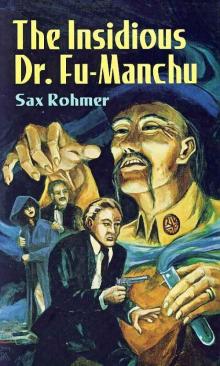
The Insidious Dr. Fu Manchu, by Sax Rohmer
Mauprat, by George Sand
The Slayer and Other Tales, by H. de Vere Stacpoole
Penrod (Gordon Grant Illustrated Edition), by Booth Tarkington
The Gilded Age, by Mark Twain
The Blockade Runners, by Jules Verne
The Gadfly, by E.L. Voynich
Please see www.wildsidepress.com for a complete list!
BROOD OF THE
WITCH-QUEEN
SAX ROHMER
WILDSIDE PRESS
BROOD OF THE WITCH-QUEEN
This edition published in 2006 by Wildside Press, LLC.
www.wildsidepress.com
PREFATORY NOTICE
The strange deeds of Antony Ferrara, as herein related, are
intended to illustrate certain phases of Sorcery as it was formerly
practised (according to numerous records) not only in Ancient
Egypt but also in Europe, during the Middle Ages. In no case do
the powers attributed to him exceed those which are claimed for a
fully equipped Adept.
S.R.
BROOD OF THE WITCH-QUEEN
5
CHAPTER I
ANTONY FERRARA
Robert Cairn looked out across the quadrangle. The moon
had just arisen, and it softened the beauty of the old college build-
ings, mellowed the harshness of time, casting shadow pools be-
neath the cloisteresque arches to the west and setting out the ivy in
stronger relief upon the ancient walls. The barred shadow on the
lichened stones beyond the elm was cast by the hidden gate; and
straight ahead, where, between a quaint chimney-stack and a bar-
tizan, a triangular patch of blue showed like spangled velvet, lay
the Thames. It was from there the cooling breeze came.
But Cairn’s gaze was set upon a window almost directly
ahead, and west below the chimneys. Within the room to which it
belonged a lambent light played.
Cairn turned to his companion, a ruddy and athletic looking
man, somewhat bovine in type, who at the moment was busily
tracing out sections on a human skull and checking his calcula-
tions from Ross’s Diseases of the Nervous System.
“Sime,” he said, “what does Ferrara always have a fire in his
rooms for at this time of the year?”
Sime glanced up irritably at the speaker. Cairn was a tall, thin
Scotsman, clean-shaven, square jawed, and with the crisp light
hair and grey eyes which often bespeak unusual virility.
“Aren’t you going to do any work?” he inquired pathetically.
“I thought you’d come to give me a hand with my basal ganglia. I shall go down on that; and there you’ve been stuck staring out of
the window!”
“Wilson, in the end house, has got a most unusual brain,” said
Cairn, with apparent irrelevance.
“Has he!” snapped Sime.
“Yes, in a bottle. His governor is at Bart’s; he sent it up yes-
terday. You ought to see it.”
“Nobody will ever want to put your brain in a bottle,” pre-
dicted the scowling Sime, and resumed his studies.
Cairn relighted his pipe, staring across the quadrangle again.
Then —
“You’ve never been in Ferrara’s rooms, have you?” he in-
quired.
Followed a muffled curse, crash, and the skull went rolling
across the floor.
BROOD OF THE WITCH-QUEEN
7
“Look here, Cairn,” cried Sime, “I’ve only got a week or so now, and my nervous system is frantically rocky; I shall go all to
pieces on my nervous system. If you want to talk, go ahead. When
you’re finished, I can begin work.”
“Right-oh,” said Cairn calmly, and tossed his pouch across. “I
want to talk to you about Ferrara.”
“Go ahead then. What is the matter with Ferrara?”
“Well,” replied Cairn, “he’s queer.”
“That’s no news,” said Sime, filling his pipe; “we all know he’s
a queer chap. But he’s popular with women. He’d make a fortune
as a nerve specialist.”
“He doesn’t have to; he inherits a fortune when Sir Michael
dies.”
“There’s a pretty cousin, too, isn’t there?” inquired Sime slyly.
“There is,” replied Cairn. “Of course,” he continued, “my
governor and Sir Michael are bosom friends, and although I’ve
never seen much of young Ferrara, at the same time I’ve got
nothing against him. But —” he hesitated.
“Spit it out,” urged Sime, watching him oddly.
“Well, it’s silly, I suppose, but what does he want with a fire on
a blazing night like this?”
Sime stared.
“Perhaps he’s a throw-back,” he suggested lightly. “The Fer-
raras, although they’re counted Scotch — aren’t they? — must
have been Italian originally —”
“Spanish,” corrected Cairn. “They date from the son of An-
drea Ferrara, the sword-maker, who was a Spaniard. Cæsar Fer-
rara came with the Armada in 1588 as armourer. His ship was
wrecked up in the Bay of Tobermory and he got ashore — and
stopped.”
“Married a Scotch lassie?”
“Exactly. But the genealogy of the family doesn’t account for
Antony’s habits.”
“What habits?”
“Well, look.” Cairn waved in the direction of the open win-
dow. “What does he do in the dark all night, with a fire going?”
“Influenza?”
“Nonsense! You’ve never been in his rooms, have you?”
“No. Very few men have. But as I said before, he’s popular
with the women.”
“What do you mean?”
“I mean there have been complaints. Any other man would
have been sent down.”
8
SAX ROHMER
“You think he has influence —”
“Influence of some sort, undoubtedly.”
“Well, I can see you have serious doubts about the man, as I
have myself, so I can unburden my mind. You recall that sudden
thunderstorm on Thursday?”
“Rather; quite upset me for work.”
“I was out in it. I was lying in a punt in the backwater — you
know, our backwater.”
“Lazy dog.”
“To tell you the truth, I was trying to make up my mind
whether I should abandon bones and take the post on the Planet
which has been offered me.”
“Pills for the pen — Harley for Fleet? Did you decide?”
“Not then; something happened which quite changed my line
of reflection.”
The room was becoming cloudy with tobacco smoke.
“It was delightfully still,” Cairn resumed. “A water rat rose
within a foot of me and a kingfisher was busy on a twig almost at
my elbow. Twilight was just creeping along, and I could hear
nothing but faint creakings of sculls from the river and sometimes
the drip of a punt-pole. I thought the river seemed to become sud-
denly deserted; it grew quite abnormally quiet — and abnormally
dark. But I was so deep in reflection that it never occurred to me to
move.
“Then the flotilla of swans came round the bend, with Apol-
lo — you know Apollo, the king-swan? — at their head. By this
time it had grown tremendously dark, bu t it never occurred to me
to ask myself why. The swans, gliding along so noiselessly, might
have been phantoms. A hush, a perfect hush, settled down. Sime,
that hush was the prelude to a strange thing — an unholy thing!”
Cairn rose excitedly and strode across to the table, kicking the
skull out of his way.
“It was the storm gathering,” snapped Sime.
“It was something else gathering! Listen! It got yet darker, but
for some inexplicable reason, although I must have heard the
thunder muttering, I couldn’t take my eyes off the swans. Then it
happened — the thing I came here to tell you about; I must tell
somebody — the thing that I am not going to forget in a hurry.”
He began to knock out the ash from his pipe.
“Go on,” directed Sime tersely.
“The big swan — Apollo — was within ten feet of me; he swam
in open water, clear of the others; no living thing touched him.
Suddenly, uttering a cry that chilled my very blood, a cry that I
BROOD OF THE WITCH-QUEEN
9
never heard from a swan in my life, he rose in the air, his huge wings extended — like a tortured phantom, Sime; I can never
forget it — six feet clear of the water. The uncanny wail became a
stifled hiss, and sending up a perfect fountain of water — I was
deluged — the poor old king-swan fell, beat the surface with his
wings — and was still.”
“Well?”
“The other swans glided off like ghosts. Several heavy rain-
drops pattered on the leaves above. I admit I was scared. Apollo
lay with one wing right in the punt. I was standing up; I had
jumped to my feet when the thing occurred. I stooped and
touched the wing. The bird was quite dead! Sime, I pulled the
swan’s head out of the water, and — his neck was broken; no
fewer than three vertebrae fractured!”
A cloud of tobacco smoke was wafted towards the open win-
dow.
“It isn’t one in a million who could wring the neck of a bird
like Apollo, Sime; but it was done before my eyes without the vis-
ible agency of God or man! As I dropped him and took to the pole,
the storm burst. A clap of thunder spoke with the voice of a thou-
sand cannon, and I poled for bare life from that haunted back-
water. I was drenched to the skin when I got in, and I ran up all the
way from the stage.”
“Well?” rapped the other again, as Cairn paused to refill his
pipe.
“It was seeing the firelight flickering at Ferrara’s window that
led me to do it. I don’t often call on him; but I thought that a rub
down before the fire and a glass of toddy would put me right. The
storm had abated as I got to the foot of his stair — only a distant
rolling of thunder.
“Then, out of the shadows — it was quite dark — into the
flickering light of the lamp came somebody all muffled up. I
started horribly. It was a girl, quite a pretty girl, too, but very pale, and with over-bright eyes. She gave one quick glance up into my
face, muttered something, an apology, I think, and drew back
again into her hiding-place.”
“He’s been warned,” growled Sime. “It will be notice to quit
next time.”
“I ran upstairs and banged on Ferrara’s door. He didn’t open
at first, but shouted out to know who was knocking. When I told
him, he let me in, and closed the door very quickly. As I went in, a
pungent cloud met me — incense.”
“Incense?”
10
SAX ROHMER
“His rooms smelt like a joss-house; I told him so. He said he was experimenting with Kyphi — the ancient Egyptian stuff used
in the temples. It was all dark and hot; phew! like a furnace.
Ferrara’s rooms always were odd, but since the long vacation I
hadn’t been in. Good lord, they’re disgusting!”
“How? Ferrara spent vacation in Egypt; I suppose he’s
brought things back?”
“Things — yes! Unholy things! But that brings me to some-
thing too. I ought to know more about the chap than anybody; Sir
Michael Ferrara and the governor have been friends for thirty
years; but my father is oddly reticent — quite singularly reticent —
regarding Antony. Anyway, have you heard about him, in Egypt?”
“I’ve heard he got into trouble. For his age, he has a devil of a
queer reputation; there’s no disguising it.”
“What sort of trouble?”
“I’ve no idea. Nobody seems to know. But I heard from young
Ashby that Ferrara was asked to leave.”
“There’s some tale about Kitchener —”
“By Kitchener, Ashby says; but I don’t believe it.”
“Well — Ferrara lighted a lamp, an elaborate silver thing, and
I found myself in a kind of nightmare museum. There was an
unwrapped mummy there, the mummy of a woman — I can’t pos-
sibly describe it. He had pictures, too — photographs. I shan’t try
to tell you what they represented. I’m not thin-skinned; but there
are some subjects that no man anxious to avoid Bedlam would
willingly investigate. On the table by the lamp stood a number of
objects such as I had never seen in my life before, evidently of
great age. He swept them into a cupboard before I had time to look
long. Then he went off to get a bath towel, slippers, and so forth.
As he passed the fire he threw something in. A hissing tongue of
flame leapt up — and died down again.”
“What did he throw in?”
“I am not absolutely certain; so I won’t say what I think it was, at the moment. Then he began to help me shed my saturated flan-nels, and he set a kettle on the fire, and so forth. You know the per-
sonal charm of the man? But there was an unpleasant sense of
something — what shall I say? — sinister. Ferrara’s ivory face was
more pale than usual, and he conveyed the idea that he was
chewed up — exhausted. Beads of perspiration were on his fore-
head.”
“Heat of his rooms?”
“No,” said Cairn shortly. “It wasn’t that. I had a rub down and
borrowed some slacks. Ferrara brewed grog and pretended to
BROOD OF THE WITCH-QUEEN
11
make me welcome. Now I come to something which I can’t forget; it may be a mere coincidence, but — He has a number of photographs in his rooms, good ones, which he has taken himself. I’m
not speaking now of the monstrosities, the outrages; I mean views,
and girls — particularly girls. Well, standing on a queer little easel
right under the lamp was a fine picture of Apollo, the swan, lord of
the backwater.”
Sime stared dully through the smoke haze.
“It gave me a sort of shock,” continued Cairn. “It made me
think, harder than ever, of the thing he had thrown in the fire.
Then, in his photographic zenana, was a picture of a girl whom I
am almost sure was the one I had met at the bottom of the stair.
Another was of Myra Duquesne.”
“His cousin?”
“Yes. I felt like tearing it from the wall. In fact, the moment I
saw it, I stood up to go. I wanted to run to my rooms and strip the
man’s clothes off my back! It was a struggle to be civil any longer.
Sime, if you had seen that swan die —”
Sime walked over to the window.
“I have a glimmering of your monstrous suspicions,” he said
slowly. “The last man to be kicked out of an English varsity for this
sort of thing, so far as I know, was Dr. Dee of St. John’s, Cam-
bridge, and that’s going back to the sixteenth century.”
“I know; it’s utterly preposterous, of course. But I had to con-
fide in somebody. I’ll shift off now, Sime.”
Sime nodded, staring from the open window. As Cairn was
about to close the outer door:
“Cairn,” cried Sime, “since you are now a man of letters and
leisure, you might drop in and borrow Wilson’s brains for me.”
“All right,” shouted Cairn.
Down in the quadrangle he stood for a moment, reflecting;
then, acting upon a sudden resolution, he strode over towards the