Puffin classics, p.1
Puffin Classics, page 1


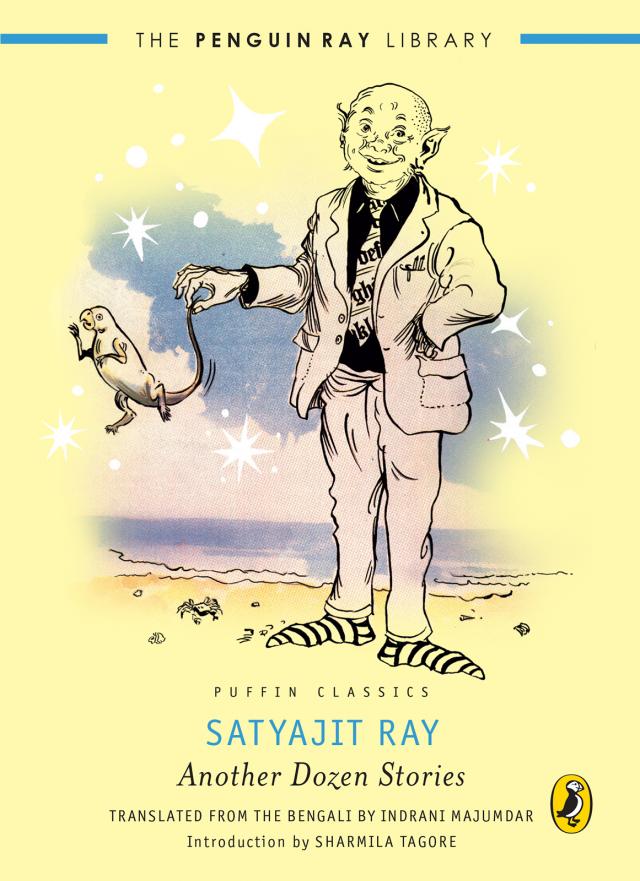
SATYAJIT RAY
Another Dozen Stories
Translated from the Bengali by Indrani Majumdar
Introduction by Sharmila Tagore
PUFFIN BOOKS
Contents
Introduction
1. The Life and Death of Aryasekhar
2. Professor Hijibijbij
3. Poisonous Flowers
4. The McKenzie Fruit
5. The First-Class Compartment
6. A Hoax
7. Worthless
8. Ramdhan’s Flute
9. Master Angshuman
10. Rocket
11. A Portrait
12. Telephone
Footnotes
1. The Life and Death of Aryasekhar
2. Professor Hijibijbij
3. Poisonous Flowers
4. The McKenzie Fruit
5. The First-Class Compartment
6. A Hoax
7. Worthless
8. Ramdhan’s Flute
9. Master Angshuman
10. Rocket
11. A Portrait
12. Telephone
Translator’s Note
Classic Plus
Follow Penguin
Copyright
Introduction
I was a young adolescent when Manik Da cast me in Apur Sansar and a year later in Debi. I have seen him engage with children, absorbing their every word, answering their every question, putting them at ease. It has been a fascinating experience.
Over the decades, I saw him creating some of the most captivating children’s characters in cinema—Apu and Durga, Kajol, Ratan and Pikoo. His own sense of wonder and curiosity at the world around him reflected through these characters and in the stories he created for children. His complete understanding of a child’s mindset, his ability to look at the world through the eyes of a child, was a rare gift he inherited from his family. His grandfather Upendrakishore Ray Chowdhury and his father Sukumar Ray were popular writers of children’s books. In Bengal, their works are still seen as milestones in the history of children’s literature. Manik-da carried this legacy forward, he revived the magazine, Sandesh, and added many more entertaining stories that appealed to children and to young adolescents.
He understood children’s psyche, their inherent love for mystery and enchantment with the magical and sci-fi. In the process, he created two of the most enduring characters for young readers, Feluda and Professor Shonku.
It is such a joy to be able to revisit some of Manik-da’s most memorable works in this genre. The stories translated by Indrani Majumdar highlight everything we have come to love and admire about Manik-da’s multifaceted creativity. It’s all here—the element of the unexpected, a hint of the supernatural, a whiff of the macabre with a generous measure of humour. This is a collection that makes me want to curl up in my bed with a pleasurable anticipation and let my imagination soar to the power of these timeless tales.
This is a befitting tribute to the master on his 100th anniversary.
Sharmila Tagore
March 2021
1
The Life and Death of Aryasekhar*
Many had expressed their opinion that Aryasekhar was a child prodigy. When Aryasekhar was only ten the last line of the first page of The Statesman caught his attention: Today the sun rises at 6.13 a.m. Carrying the paper with him, Aryasekhar went to talk to his father, Soumyasekhar.
‘Father.’
‘What’s the matter, my son?’
‘What have they written in the newspaper?’
‘What have they written?’
‘The sun will rise at 6.13 a.m.’
‘Of course, they are quite correct. The sun rises exactly at that time.’
‘Did you check your watch?’
‘There’s no need.’
‘Why?’
‘It’s assumed.’
‘How?’
‘It’s a matter of scientific calculation. Astronomy.’
‘What if the sun doesn’t rise at the right time?’
‘The watch must be incorrect.’
‘Suppose it’s not incorrect?’
‘Then what? Time for apocalypse?’
This marked the initiation of Aryasekhar’s interest in scientific investigations. Two years later he approached his father with yet another query.
‘Father.’
‘Yes.’
‘Are the moon and the sun the same in size?’
‘Don’t be stupid.’
‘Then?’
‘The sun is infinitely bigger.’
‘How big?’
‘By several million times.’
‘Then why do they appear to be of the same size?’
‘That’s because the sun is much farther off.’
‘The distance should be so precise that they appear to be of the same size?’
‘Yes.’
‘How did this happen?’
‘No idea, really. After all I’m not the almighty.’
Here it must be mentioned that Soumyasekhar is not a scientist. He is a lawyer by profession.
After this conversation with his father, all that Aryasekhar could comprehend was that the apparent equality of the sizes of the sun and the moon was just an amazing coincidence. This hitherto unknown information created a major intrigue in his mind. Ignoring his textbooks, he opened his father’s almirah, and taking out ten volumes of Harmsworth Popular Science, began to study the chapters on stars and planets. Needless to add, in this mission, he often had to turn to dictionaries for help. But this did not hold him back. A remarkable harmony of imagination and concentration in the boy helped him to carry on in his work.
On his fourteenth birthday, Aryasekhar opened a drawer of his father’s table and took out three unused diaries. Choosing the largest one he wrote on the first page: In my view, if any other living beings happen to exist in this solar system they can never be like us humans chiefly because there’s nothing to match our sun or moon in those planets. In case there was, there would have been similar figures like humans. To me a human is a human only because of the presence of the moon and the sun.
The following year, Aryasekhar, on a whim, began to verbally solve the trickiest of mathematical problems. Apart from the obvious problems involving addition, subtraction, multiplication and division, there were also problems which belonged to a rather advanced level of mathematics. For instance, Aryasekhar could guess the speed of a kite, its height from the ground level and the perimeter of the kite’s flying area.
Aryasekhar’s private tutor, Monilal Majumdar, could not reconcile to his student’s brilliance in scientific matters. So out of sheer embarrassment, he decided to resign. Soumyasekhar too was at once amazed and alarmed to observe his son’s conduct. Thanks to Soumyasekhar himself, and the initiatives taken by some of his friends and clients, a few reputed mathematicians of the city began to take notice Aryasekhar’s unique abilities. The mathematics professor of Presidency College, Jibanananda Dhar, himself came and tested Aryasekhar for almost three-and-a-half hours using various methods, and left a glowing recommendation letter for him. In it he wrote, ‘In his ability to solve these mathematical problems mentally/orally, I won’t be surprised if Aryasekhar in no time surpasses Somesh Bose*. I wish this exceptionally talented youth a very long life.’
If the prospect of an added income beckons one, even a well-to-do person generally succumbs to it. Soumyasekhar was comfortably well off, but it wasn’t really unnatural for him to be tempted to explore the possibility of an additional income by taking advantage of his extraordinarily talented son. But he had no plans to embark on such a mission without informing his son. He called for Aryasekhar.
‘Well, I have been mulling over an idea.’
‘What about?’
‘With me—you know what I mean—the times we are facing now—one’s not doing that well, getting by somehow. As we have observed such talent in you, the way everyone’s praising you . . . doesn’t it sound almost like magic? Suppose you showcase this talent to an audience—I mean after choosing a suitable venue with a well-organized . . .’
As he spoke, Soumyasekhar noticed an enraged, distressed look on his son’s face. He felt ill at ease. He stopped talking for the moment and changed his tune to add, ‘If, however, you have any reservations about this, no question arises.’
‘Entertainment and talent are not the same thing, Father.’ A question now crossed Aryasekhar’s mind thanks to his father’s suggestion. How can such an exceptionally talented son have a father with such a pathetic mentality? Was this polar opposite of attitudes between a father and son normal or was it an exception?
And if this was an exception, what was the scientific explanation behind it? There was no dearth of time in Aryasekhar’s life because soon after discovering his mathematical genius, Soumyasekhar had taken him out of school. Aryasekhar now began an in-depth study on heredity and reproduction. Soon enough he discovered the significance of genes. In the genetic code present in each human being a few molecules indicate the nature, appearance and character of one’s forefathers and of the future generations. How incredible!
Aryasekhar, once more, stood in front of his father.
‘Father, don’t we have a family tree?’
‘A family tree? Why?’
‘Do we have one?’
‘Even if there ever was one, it must have been eaten up by termites. Why, do you think you are some sort of reincarnation? Or something similar?’
‘No. I was thinking whether any predecessor in our family had been extraordinarily gifted. I know of you and grandfather. But prior to that?’
‘Not a soul for the past seven generations. I can guarantee it. I’ve no knowledge of our history prior to that.’
After returning to his room, Aryasekhar plunged into deep thought. No gifted person in the last seven generations on my father’s side. The same could be vouched for my mother’s side—in fact the chances here were even more remote. Niharika Debi was a lady of very mediocre abilities. As she still referred to him as ‘my boy’, Aryasekhar made it a point not to go anywhere near her.
The influence of heredity was uncertain. Milieu? Environment? Can 33 Patuatala Lane be considered significant in this respect? Probably not. Then?
Can everything be proven simply on the basis of calculation? Father’s father, his father—one can trace the very beginning of creation through a family tree. Hasn’t the influence of genes been working since then? One wonders who and how were Aryasekhar’s predecessors twenty thousand years ago? It was probable that one of them had drawn the picture of a bison on a wall of a cave in Altamira. Can’t one speak of these prehistoric cave painters as belonging to the category of genius? Or the people who had planned a city like Harappa or Mohenjo-Daro? Or the writers of the Vedas and the Upanishads? If anyone of them could be traced as Aryasekhar’s forefathers, there was no further reason for worry. Yet his mind was not at rest. He couldn’t find any scientific cogency in the fact that a person like Soumyasekhar—so devoid of imagination, so grounded in the everyday world and so utterly dull—could be his father.
While fretting about this, a sudden thought struck him.
What if he was an illegitimate child? What if he had not been born out of Soumyasekhar’s genes?
The instant this thought struck him, Aryasekhar realized that such a question could only be answered by his father and until he got the response he could not be at peace. That a son would question his father in the search for truth was to Aryasekhar just matter of course. Deeply immersed in a 926-page bulky law directory, Soumyasekhar initially could not even comprehend his son’s question.
‘Are you talking of a twin? Who are you referring to?’
‘Not about a sibling. I want to know if I’m an illegitimate child.’
Hearing these words, Soumyasekhar’s lips twitched. A trace of a quiver appeared between them. Soon that quiver spread throughout his body. And at that moment his right hand, which had been shaking, couldn’t find anything other than a heavy paperweight. He picked that up and flung it straight in Aryasekhar’s direction. Aryasekhar screamed in pain and collapsed on the floor with a bleeding head.
After his recovery it was observed that Aryasekhar had lost his supernatural power in mathematics. But he still retained his zeal for scientific research.
When Aryasekhar was nineteen years old, one evening as he was sitting under a sirish tree by the banks of the Ganga the droppings from a bird which was perched on the tree fell on his left shoulder. All of a sudden, he became aware of gravity. Typically, he began to research to educate himself further about this. He had earlier thought that the incident of Newton and the apple was an imaginary one. But after reading Newton’s own writing in Principia, Aryasekhar changed his mind. Starting with Tycho Brahe, and moving on from Galileo to Copernicus, Kepler and Leibnitz, he finally reached Einstein. At Aryasekhar’s level of education it wasn’t easy to understand Einstein, yet Aryasekhar had an extraordinary knack of reading up all kinds of books—readable or unreadable, comprehensible or incomprehensible—from cover to cover. But in the present context, his eagerness was fixated on whether the last word had been said about the law of gravity. After reading Einstein, though he could follow what exactly the law of gravity was, why was so much still unknown to him? He decided that this search for ‘why’ would now be his chief mission in life.
From that day, Aryasekhar decided he would pay attention to all trivial matters in life. He knew that insignificant incidents like the apple falling on Newton lay behind many discoveries.
Unfortunately, even after observing more than a thousand banal events over a period of three months he couldn’t come across any incident whose scientific explanation had not already been recorded. Left with no choice, Aryasekhar had to look for a different strategy. With the firm belief that one needs to immerse oneself in meditation before attaining knowledge he too decided to meditate. With this purpose in mind, he went up to the attic.
It was a Sunday. He went to the attic and sat down on a wooden cot. Just as he was about to shut his eyes, an insignificant scene on the terrace next door caught his attention through the open window. Their neighbour Phanindranath Basak’s seventeen-year-old daughter, Dolly, had lifted her hands to hang her washed clothes on a rope. This scene, in the flash of a second, aroused in Aryasekhar’s mind a fresh new angle to the law of gravity.
Within seven days he wrote down his observations in a 133-page article penned on foolscap sheets. It’s not possible to fully describe his observation in this short biography, but he had noticed the following. Life itself is a protest against gravity because life force takes us to a higher plane whereas gravitation does the opposite. How did life at all evolve in spite of anti-life forces like gravity? The reason is the sun. But the sun’s influence is not omnipotent. In the constant clash with gravity, the sun’s influence, too, wanes. Consequently, the influence of gravity first strikes old age and finally death strikes life. In every sphere of human life—in its work, in its capacity for thought, in its sentimental outpourings—this opposition to gravity reigns supreme. All inferior qualities in humans, society’s immoral practices, injustice, poverty, sorrow, distress and plans for warfare are all due to gravity. And whatever is striking, lively, prosperous and auspicious is credited to the impact of the sun. Due to the presence of gravity, the earth will never be free of mishaps. The earth would have been destroyed long ago, but the sun did not allow this to happen. Hence, destruction and creation have always existed simultaneously since time immemorial.
After completing this article, when Aryasekhar emerged from the attic he first acknowledged his gratitude to the sun and then to his neighbour, Dolly. At this precise moment their family retainer, Bharadwaj, informed him that his father had called for him.
Over the past few days Soumyasekhar had been worrying about his son. He had lost his wife Niharika the previous year. On her deathbed, she had lamented not having had the opportunity of seeing her son settle down.
Aryasekhar rolled up his papers and stood in front of his father.
‘What will you turn out to be? A snake, a frog or an insect?’
‘This can’t be decided till the nature of my genes has been identified.’
‘Whose nature?’
‘Genes.’
‘Half the time I can’t follow you.’
‘Not everyone can follow everything. Do I know anything about the legal profession?’
‘Hope you follow that you survive today thanks to my profession. But at your age, it is not honourable to live off your father. So don’t discuss genes or other such stuff with me. Whatever you do sitting in that attic, please remember that you are no better than any idler on the street. I give you a year’s time. Please look for a job. As you are devoid of any degree, I don’t expect much from you. But you ought to become self-reliant. Then the other task can be taken up.’
‘What other task?’
‘You ought to think about our lineage. Or have you decided not to marry?’
‘Yes.’
‘You will not marry?’
‘No.’
‘May I know why?’
‘First of all, I’ve my doubts about my begetter.’
Soumyasekhar almost choked. Aryasekhar gave him time to recover his composure.
‘Secondly when the influence of the sun is so crucial to my life, I don’t need anything to impede my work or my deliberations.’
‘Have you been initiated into some religious faith?’
‘You may say that.’
‘What faith?’
‘It is my personal faith. A name is yet to be coined for it.’
For a moment Soumyasekhar had hoped that he may have solved the mystery of his son’s unusual temperament. Now he knew that it was not to be. He gazed at his son for a while. In particular, at his eyes. Did his looks reveal any sign of insanity? Soumyasekhar’s great-grandfather, who had become senile in his old age, had once gone to the temple, where the entire village was gathered during Durga Puja, wearing no clothes. Not once had Soumyasekhar mentioned this incident to his son. A gentle compassion for Aryasekhar surfaced in Soumyasekhar. After all he was his only child—the only begotten. Let him be as he was—as long as he remains alive. And let him not lose his mind.