Chaos comes calling, p.1
Chaos Comes Calling, page 1


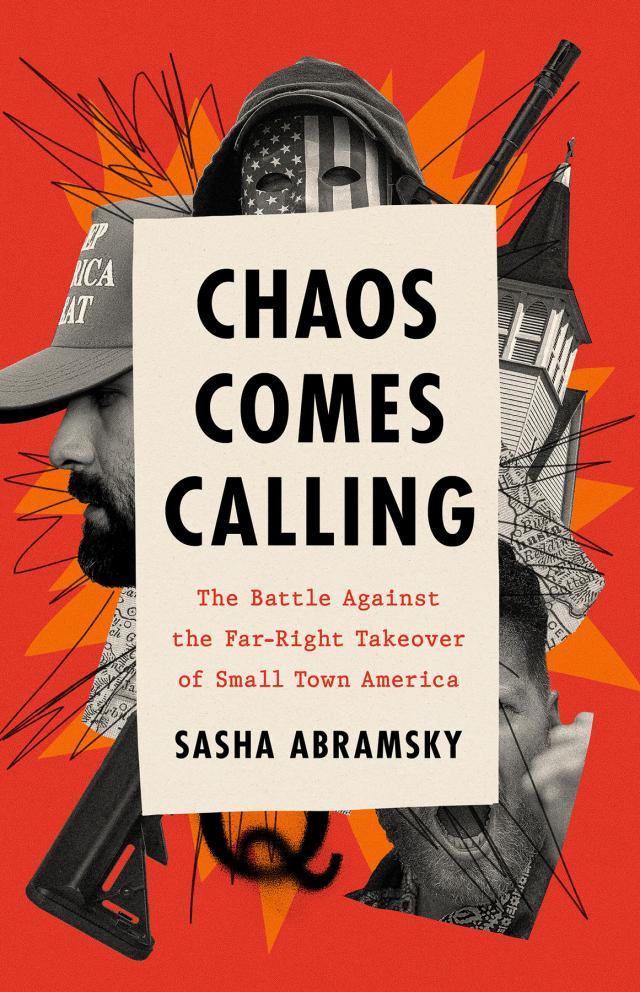
Copyright © 2024 by Sasha Abramsky
Cover design by Pete Garceau
Cover images copyright © J M Giordano/SOPA Images/Shutterstock.com; iStock/Getty Images
Cover copyright © 2024 by Hachette Book Group, Inc.
Hachette Book Group supports the right to free expression and the value of copyright. The purpose of copyright is to encourage writers and artists to produce the creative works that enrich our culture.
The scanning, uploading, and distribution of this book without permission is a theft of the author’s intellectual property. If you would like permission to use material from the book (other than for review purposes), please contact permissions@hbgusa.com. Thank you for your support of the author’s rights.
Bold Type Books
Hachette Book Group
1290 Avenue of the Americas, New York, NY 10104
www.boldtypebooks.org
@BoldTypeBooks
First Edition: September 2024
Published by Bold Type Books, an imprint of Hachette Book Group, Inc. Bold Type Books is a co-publishing venture of the Type Media Center and Perseus Books.
The Hachette Speakers Bureau provides a wide range of authors for speaking events. To find out more, go to hachettespeakersbureau.com or email HachetteSpeakers@hbgusa.com.
Bold Type books may be purchased in bulk for business, educational, or promotional use. For more information, please contact your local bookseller or the Hachette Book Group Special Markets Department at special.markets@hbgusa.com.
The publisher is not responsible for websites (or their content) that are not owned by the publisher.
Print book interior design by Amy Quinn.
Library of Congress Cataloging-in-Publication Data
Names: Abramsky, Sasha, author.
Title: Chaos comes calling : two small counties and the epic battle for America’s soul / Sasha Abramsky.
Description: First edition. | New York : Bold Type Books, 2024. | Includes index.
Identifiers: LCCN 2024000153 | ISBN 9781645030430 (hardcover) | ISBN 9781645030454 (ebook)
Subjects: LCSH: Radicalism—California—Shasta County. | Radicalism—Washington (State)—Sequim. | Right-wing extremists—California—Shasta County. | Right-wing extremists—Washington (State)—Sequim. | Political culture—California—Shasta County. | Political culture—Washington (State)—Sequim. | Political culture—United States.
Classification: LCC HN79.C22 S533 2024 | DDC 320.53/30979424—dc23/eng/20240410
LC record available at https://lccn.loc.gov/2024000153
ISBNs: 9781645030430 (hardcover), 9781645030454 (e-book)
E3-20240709-JV-NF-ORI
CONTENTS
Cover
Title Page
Copyright
Dedication
Epigraph
Introduction: Flooding the Zone with Shit
Part One: Sequim, Washington 1 The Good Doctor
2 PTSD
Part Two: Shasta County, California 3 Item “R2”
4 A Pressure Cooker Primed to Explode
5 The Red White and Blueprint
Part Three: Fake Facts and Culture Wars 6 The Men with Long Guns
7 Red Pills and Shock Jocks
8 “Ima Plant” and the Rise of the Election Deniers
9 Chaos
10 The Culture Wars Come to Town
11 Book Bans, Flat-Earthers, and Death Threats Against the Weatherman
12 “We Want to Kill You”
Epilogue
Acknowledgments
Discover More
About the Author
Also by Sasha Abramsky
To my darling Marissa, who makes me laugh and keeps me even-keeled. I look forward to our endless adventures together.
And to my wonderful children, Sofia and Leo, who fill my days with pride and joy. May you always keep your fine-tuned sense of right and wrong.
Explore book giveaways, sneak peeks, deals, and more.
Tap here to learn more.
“For every action there is an equal and opposite reaction.”
—Isaac Newton
“Don’t talk unless you can improve the silence.”
—Jorge Luis Borges
“The vulgar proclaims and imposes the rights of vulgarity, or vulgarity as a right.”
—José Ortega y Gasset
Introduction
FLOODING THE ZONE WITH SHIT
Dr. Allison Berry, public health officer for Clallam County, Washington, sat at a table at the Rainshadow Café in downtown Sequim (pronounced “Squim”), a town of 8,000 residents on the Olympic Peninsula, 110 miles northwest of Seattle. She readied herself to tell me about the tsunami of hatred that had come her way during the COVID-19 crisis.
Since the pandemic began and she had introduced local mitigation measures to slow the spread of the deadly virus, Berry had been receiving threats on a near-daily basis. It was December 2021, eighteen months into the calamity, and the young doctor still had a target on her back. “Hundreds of hate mails,” she said. “It was mostly in a really misogynistic direction. Think of your most colorful misogynistic language, and that’s what came my way.”
Six months earlier, in June 2021, with the COVID vaccine campaign well under way and with most elderly and immunocompromised residents double-vaccinated, Washington’s governor, Jay Inslee, had reopened the state, allowing “nonessential” businesses to function again and people to congregate without limitations on number or setting. New variants of the virus were starting to pick up steam, however, and—as public health officials had predicted would be the case—despite the widespread vaccination effort, the number of COVID infections immediately surged. “We just couldn’t hold it back,” Berry recalled. “People were indoors regardless of vaccination status, with masks off. People were traveling. The message had been sent that the pandemic was over.”
Just like that, in Clallam County the caseload shot up to 1,300 per 100,000 residents over a two-week period. The contact-tracing system that Berry and her team of tracers, which had grown from three people to roughly twenty as the pandemic ground on, had operated so effectively for the first year of the pandemic—speedily shutting down local outbreaks through a rigid regimen of tracing and concentric testing—broke down under the stress. The local hospitals were overwhelmed: every bed was full, and so many staff were out sick that the facilities were having to call in trainee EMTs to work in the emergency rooms. Doctors were putting together makeshift negative-pressure breathing rooms in which they could house the growing number of intubated patients, and the county’s few respiratory therapists were working virtually around the clock. Local residents were so scared of getting infected while in the hospital that some stayed away, even when they were experiencing life-threatening medical emergencies such as strokes. And even if they weren’t scared off, many had no way of getting to the hospital: ambulance crews were so busy that critically ill patients were forced to wait hours for the vehicles to arrive to transport them. And then, once they arrived, they would have to wait ungodly long times to be seen by the frantically busy doctors. Stroke victims were languishing up to eight hours in the emergency room, their brains accumulating more and more permanent damage. Seriously ill COVID patients, their oximeter readings showing dangerously low oxygen levels, likewise had to wait hours before they were admitted.
“I was getting calls from doctors in tears, saying, ‘Everyone’s dying,’” Berry said. “One told me, ‘I’ve intubated five people today.’ The health system’s on fire, and everything else is normal. The bars are open, people are partying. The disconnect was incredible.”
Knowing that putting in place another local shutdown order just after the state had officially reopened would create a firestorm, Berry, along with two public health officials in neighboring counties on the peninsula, scrambled to find a solution. At first, she chose to reinstate mask mandates. Given the message coming out of the state capital, Olympia, that everything should reopen and that people could get on with their normal lives, it seemed the least draconian response. But it soon became clear that restaurants and bars—the venues in which diners and drinkers were still allowed to congregate maskless—were epicenters of the rampaging COVID surge. Contact tracers estimated that in one bar alone a trivia night had resulted in two hundred new cases and at least two deaths. When Washington State as a whole followed Clallam County’s lead and introduced a mask mandate, its public health teams also found that it wasn’t putting the brakes on the surge.
After two weeks in which, despite the new masking mandate, COVID rates continued to spiral upward, Berry contacted the county’s lawyers. Labor Day was fast approaching, and she knew that tourists would soon be swarming onto the peninsula. The new school year was about to begin, and there were rumblings of having to return to Zoom classes if the county’s surge couldn’t be rapidly tamed. For the public health officer, it seemed madness to keep bars functioning as normal at the cost of having to remove kids from the classroom for another school year. She wanted to implement what she thought was the next-least-bad option, certainly less of an economic ball and chain than restricting eateries to 50 percent capacity: an order mandating that to be allowed to enter a local eatery or bar, patrons would have to produce proof of vaccination. The lawyers set to work drafting language that they believed would stand up in court, and Berry got to work preparing to issue the new regulations. “I was nervous about it; I knew I was going out on a limb,” she recollected. “But I felt really confident i t was the right thing to do. I was thinking: this is my responsibility. There’s not many other people who can do it. I have to do my job. And so I did.”
Within days, with most restaurants and bars complying with the orders—only four anti-vaccination owners took preliminary steps to sue Berry, litigation that they would ultimately abandon after she promised to lift the mandate by March 2022—the COVID infection rate began to fall, and within a couple of weeks the hospitalization and death rates in the county also plummeted. After about a month, the new case rate had dropped not just marginally but like a stone, retreating from a high, at the time Berry put in place the mandate, of more than 1,300 new cases per 100,000 residents in a given two-week period down to 207. Berry’s instincts had been proven right. A month later, officials in Olympia acknowledged the success of the strategy and extended the proof-of-vaccination mandate to include the entire state of Washington.
By then, however, Berry had attracted the venomous interventions of anti-vaxxers not just in Sequim, not just in Clallam County, not just in Washington, but around the world. “I knew there’d be push-back [to the vaccine mandate],” Berry later recalled. “But I had no idea what was coming.”
The morning after she posted about the mandate on her office’s Facebook page, she woke up to find that the post had been shared thousands of times and that people from around the world were registering their disgust at the vaccine requirement. “People saying they knew where I was,” people threatening to hunt her down and kill her. “I didn’t anticipate that level of animosity. It was scary. I was living alone with my toddler in a studio in farmland without lights. I knew people were trying to find us, and I heard people were narrowing in on where I lived. I couldn’t let my toddler play outside. I was like, ‘What have I done? Am I going to get killed? I’m her only mom. Am I going to get my daughter killed?’”
Recently separated from her husband and raising her toddler daughter as a single mom, Berry suddenly found herself front-center stage in a bitter conflict that risked tearing the country apart. Armed mobs began showing up outside her public health offices, threatening to lynch the doctor and her colleagues. When the phones rang in her office, her colleagues girded themselves, knowing that there was a pretty good chance the person on the other end of the line would begin hurling obscenities at them as soon as they answered. When Berry opened her emails, she steeled herself for the barrage of hateful, frequently obscene messages that would flood her inbox.
Generally, Berry felt, with a justifiable pride, that she was hard to scare. But as she admitted, “I was scared here. I was absolutely scared here. I’m definitely scared of white supremacists and misogynists who want me dead.” The emails, especially, gave her the chills.
“You’re a brazen hypocrite who gets off on torturing children, much like your creepy Nazi pope gets off on torturing puppies. Moreover, you, and anyone going along with your mass, coerced medical experiment and the prolonged torture of children, will face judgement,” went a fairly typical one, dated October 28, 2021. After a few more venomous paragraphs, the author signed off with a “Happy Halloween.” It was, to say the least, creepy, but when Berry forwarded it to the sheriff’s office, the sheriff determined that it didn’t rise to the level of a specific criminal threat.
On Facebook, one outraged anti-vaxxer waxed that “it is my religious freedom to not get vaccinated.” And then, using most unreligious language, he waned, “Fuck every single one of you cunts.”
Hundreds of miles to the south, in California’s sparsely populated Shasta County, public health officer Karen Ramstrom, along with her supporters in county government, were facing a similar set of terrors.
As COVID spread, and as local public health officials desperately tried to craft regulations to keep the populace safe, talk-radio hosts would go on their shows and tell their audience of anti-vaxxers, anti-maskers, anti-RINOs (Republicans in Name Only), and anti–Black Lives Matters that it was time for blood to flow in the streets. “Communists only recognize the limits of their power when their necks are stretched,” opined one shock jock on the Redding-based KCNR 1460 AM radio station, whose shows were subsequently scrubbed from the radio station’s archives after he veered too far into the language of violence. A Facebook group called Open Shasta put up a posting about “taking out Dr. Ramstrom.” A flood of other online threats soon followed. Anti-vaxxers picketed the public health offices. Fearing violence, the Redding Police Department ramped up patrols of Ramstrom’s neighborhood.
So intimidating were the threats that, for a short time, Ramstrom even had a security team stationed outside her house. She put up cameras around her home; after a slew of particularly horrifying threats, she had to give statements to investigators from the DA’s office.
When she looked to the county’s elected officials for support, Ramstrom was rebuffed. Several hard-right members of the county board of supervisors pointedly refused to meet with the public health officer to show their support for her in light of the threats that she was facing. Instead, they urged their colleagues to go to bat against the county’s and the state’s public health responses, and to refuse to enforce the lockdown, nonessential business closings, and masking mandates. When the more moderate members balked at this, the hard-right contingent, backed by local militia members, “parents’ rights” advocates, and a bevy of fundamentalist churches, pushed a recall campaign against them and, in doing so, turned Shasta County into an epicenter for the burgeoning anti-vaccine and anti-masking movements building to a head across America.
By 2022, most of the moderates had been driven out of county government. Ramstrom herself, after enduring months of protests against her, had been fired, as had many of the other top officials in public health and community services in the county. And the new hard-right majority on the board of supervisors, perhaps having realized the political potency of a heavily armed crowd, was pushing to make the rural locale a “Second Amendment sanctuary county.”
On some levels Clallam County’s and Shasta County’s travails were hardly new. Pick pretty much any period in US history, and one can find a goodly assortment of demagogues and political hustlers, snake-oil salesmen and apostles of violent confrontation. Father Coughlin used his radio platform to blame Jews for the ills of the Great Depression. Senator Joe McCarthy used televised congressional hearings and stump speeches to bandy about fictitious lists of supposed Communist infiltrators in the army, in the civil service, in universities, and in Hollywood to raise his profile as America’s ultimate Cold War Warrior. There have been know-nothings who blamed the country’s ills on immigrants and religious diversity; populists such as President Andrew Jackson and Louisiana governor Huey Long who promised salvation to their followers and destructions of their enemies, real and imagined; military figures who gloried in the particularly creative torture and execution of resistance fighters in the Philippines; and newspaper editors and owners who used their platforms to sell to the public everything from eugenics to racially based immigration restrictions to patent medicines and elixirs of youth. There have been Hitler-sympathizing demagogues who riled up crowds of a few thousand here, a few thousand there. There have, of course, been those in positions of power who embraced the wave of lynching that swept the Jim Crow South in the century following the end of the Civil War, and men such as President Woodrow Wilson, who viewed the Ku Klux Klan as necessary defenders of southern virtue and white womanhood. And there have been those, like Jim Jones, who founded death cults to ensnare the emotionally vulnerable.
What is different about today’s cast of characters selling their snake oil and their conspiracy theories isn’t their irrationality per se, or even the violence that they preach, but their reach: the fact that, largely via social media and right-wing TV and talk radio in an era of 24/7 news and lightning-fast communications, their desire to burn down the pillars holding up the US democratic experiment can so rapidly percolate through all levels of society. Their disinformation isn’t necessarily more toxic to individual users; it’s just being distributed far more effectively. In consequence, it is adopted by a lot more people, who are posing a larger stress test for key political institutions and cultural norms than did most previous waves of conspiracists and ideologues. And when other disrupters, other black-swan moments, are added into the mix—Donald Trump’s election to the presidency, the pandemic, the vast racial-justice protests of 2020, say—those snake-oil salesmen simply crank up the volume and ramp up their destructive sales pitch, urging Americans at both the local and the national level not to coalesce around common goals but to retreat into their echo chambers, into their real or figurative bunkers, to regard their opponents as enemies to be eradicated. And by the tens of millions, that is what Americans are now doing.