

Mutuwhenua, p.1
Mutuwhenua, page 1


PENGUIN BOOKS
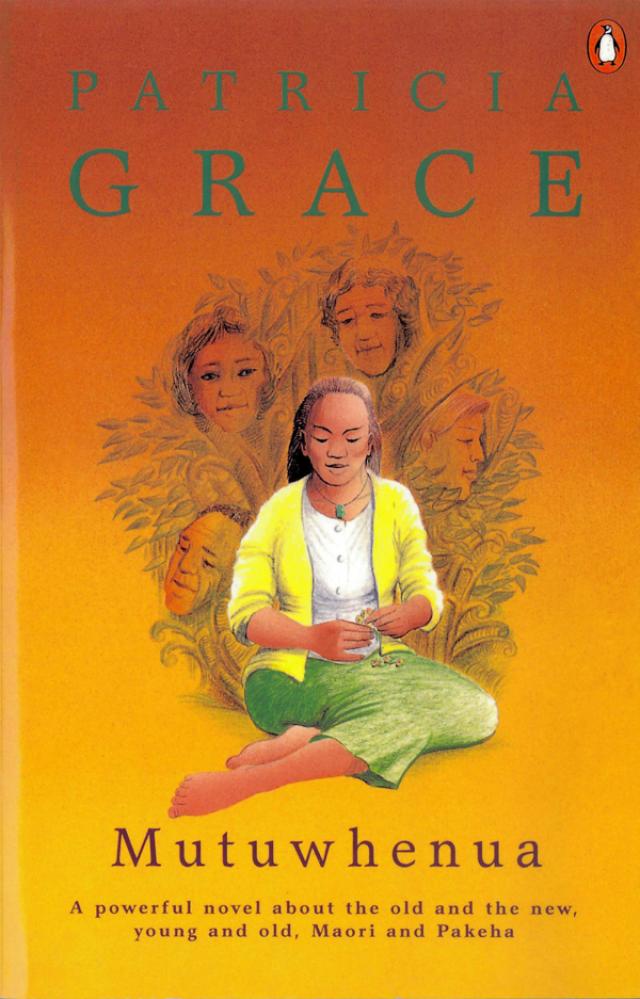
MUTUWHENUA
Patricia Grace is the author of five novels, four short story collections and several children’s books.
Awards for her work include the New Zealand Fiction Award for Potiki in 1987, the Children’s Picture Book of the Year for The Kuia and the Spider in 1982 and the Hubert Church Prose Award for best first book for Waiariki in 1976. She was also awarded the Liberaturpreis from Frankfurt in 1994 for Potiki which has been translated into several languages. Dogside Story was longlisted for the Booker Prize and winner of the Kiriyama Pacific Rim Fiction Prize in 2001.
Patricia Grace was born in Wellington in 1937. She lives in Plimmerton on the ancestral land of Ngati Toa, Ngati Raukawa and Te Ati Awa in close proximity to her home marae at Hongoeka Bay.
Patricia Grace
MUTUWHENUA
PENGUIN BOOKS
Contents
Chapter 1
Chapter 2
Chapter 3
Chapter 4
Chapter 5
Chapter 6
Chapter 7
Chapter 8
Chapter 9
Chapter 10
Chapter 11
Chapter 12
Chapter 13
Chapter 14
Chapter 15
Chapter 16
Chapter 17
Chapter 18
Chapter 19
Chapter 20
Chapter 21
Chapter 22
Glossary
To Kerehi Waiariki Grace
1
The days before my wedding were full and busy ones but more so for my mother than for any of us. It was summer, with the sun skidding day after day across a flawless ice-blue sky, taking with it all moisture from creeks and pastures, draining the hills and gullies to a sleek ivory. It was the nearest we would get to a white Christmas in these parts.
Earlier, the ti kouka far at the back of the house had given warning of this dryness, spilling out streamer after streamer of cream flowers from among its bundles of speared leaves.
The ti kouka had been brought down from the bush when my father was a small boy; in front of it stands a ngaio tree that was planted at the time I was born.
From without it has a peaceful appearance, the ngaio tree, with its tidy rounded shape and its even green. Not until you get in close to it do you discover the pained twisting of its limbs and the scarring on the patterned skin, but even so it is a quiet tree. I was named after it. A new name in our family, but I was given one of the old names as well.
Behind the ngaio and the ti kouka stands an old macrocarpa, with nodules of cones crowding the long rocking limbs and hiding among the scented sheaths of green spikes and tangles of dead twigs. I don’t know how old it is. I know only that its roots are thick and heavy and that they spread wide and deep. Only that its sap flows thickly under the flaking hide and that, without its strength against the wind that licks through the gully there, the others – the ti kouka and the one that gave me the name – would not have taken root and flourished.
After my mother had grown used to the idea of my getting married she began to enjoy all the preparation and organising for my wedding. She wanted everything to be right. We bought material which I took to a dressmaker in town to make up for Lena and me. She made bookings with the photographer and florists and arrangements for the cleaning and decoration of our church and dining-hall.
My father was busy too, but I’d never seen him so quiet. It was almost as though he had hidden his real self away and left a silent stranger in his place, coming and going, eating and sleeping. It was a new mood, this quiet one, that didn’t sulk or shout, cry or laugh or stamp about. One I didn’t know.
‘What’s the matter with my Dad?’ I asked one day, and he sat quiet for so long I thought he wouldn’t answer me at all.
‘It’s all this wedding business,’ he said, and was silent again.
‘It’s too much trouble and all that?’
‘Nothing’s too much trouble for my girl.’
‘What then?’
‘You don’t know what it’s like yet. To be married. Away from home.’ He put his arm round me. ‘It’s our fault, Mum’s and mine. We’ve kept you too close to us. You might not be ready to leave. Perhaps you and Graeme might be more different from each other than either of you can tell.’
It startled me for a moment to hear my own fear spill out into the room on my father’s voice. And something made me think just then of the stone we had found, that was buried now at the bottom of a deep gully not far away. I felt a touch of stone on me, but not too coldly. Hold it a while and soon it warms, taking life and warmth from you.
‘But you let us marry. You want it.’
‘You’ll need someone else one day. And I know he loves you very much. He’s proved that to me; he has a lot of strength in him.’
I had always wanted to tell Graeme about the stone, which I call a stone to give less meaning, to simplify feeling. But I was afraid of what I might come to know about him and me, of what there could be between us, what differences. I have put many things aside over the past few years but the stone remains with me. The stone and the people do not let me forget who I am although I have wanted to many times.
‘And it’s your Nanny,’ my father said. ‘She doesn’t like it. She won’t come, you’ll have to be prepared for that, Baby. And she blames me of course.’
Ripeka was the other name they gave me, after her.
‘No doubt you are a good-looking young man,’ Nanny Ripeka had said to Graeme. ‘But my grand-daughter should marry a Maori.’
‘But I love her,’ he said. ‘No one can love her more than I do.’
‘You know nothing,’ she replied. ‘Love? Love is what you’re born with and what you know. You think you know this girl but what do you know? What’s wrong with a Pakeha girl for you?’
Then Nanny Ripeka had turned to me and said, ‘You’re as bad as that cousin of yours. Never mind the Maori; he must marry a Pakeha. Both of you just want your children to have fair skin because you think that’s better. You care nothing for your own people.’
And I got angry with her, and not for the first time. I was crying, and wanting to shout, to try to make her understand; crying because there was nothing I could say that would make any difference to what Nanny believed. And I thought on the way home how glad I would be to marry Graeme and get away from Nanny Ripeka and all her cranky ideas.
‘What’s wrong with her?’ my father asked Graeme when we arrived home.
‘The old lady … said things,’ Graeme said.
Then I sat down and told my mother and father what had happened. I was still crying. ‘Well, your Nanny’s old now,’ my father said. ‘and you can’t make anything any different by being angry with her.’
‘She doesn’t have to say those things.’ But my father didn’t answer me. ‘Well, does she? I suppose you agree with her. You think she’s right.’
‘I’m glad you’re marrying Graeme,’ my father said. ‘He’s a good boy and he loves you.’
‘What’s wrong with you? Can’t you give a straight-out answer any more?’ It was as though Graeme wasn’t there.
‘There’s some truth in what the old lady says,’ my father said. ‘But you have to live a long time before you know it.’
My mother put her arms round me but I pushed her away.
‘Let’s go,’ I said to Graeme. He had been sitting away from us, and for the first time I disliked his quietness and calm.
‘Where to?’ he asked.
‘Anywhere. I want to get out of here.’
I heard him say to my father, ‘We’ll drive round for an hour, then I’ll bring her back.’ I was angered by Graeme’s quiet acceptance. ‘None of you will listen,’ I said as I went to the door. ‘Nanny Ripeka can say anything she likes, and because she’s old you think she’s right.’
We drove in silence for some time before Graeme said, ‘Don’t worry, Linda. Don’t worry about what she said. We’re strong enough you and I.’ ‘I’m not,’ I said. ‘I’m not strong at all.’ And I was still upset. But it was fear, I think, about what she’d said, rather than anger. ‘Then I’m strong enough for both of us,’ he said. ‘Don’t be unhappy. Your old man is the only one who realises the strength I have in me.’
I thought quietly for some time, wondering about what he had said to me. And quite suddenly I felt a longing for him, which was not by then a new feeling but only new in intensity. I could feel my skin tight across my body and longed to be comforted by him and to feel his strength surge through me. He looked at me and put out an arm to draw me close to him, but we drove homewards. His body was hard beside mine.
2
I was nine years old when we found the stone. Grandpa Toki was alive then and my parents and I had gone to his place because a man from the council was to be there to discuss with my grandparents and the rest of the family a road that the council wanted to put through our settlement to open up more land in the area. My grandparents’ place is a mile or so from our place, on a small rise, with the hills stacking up behind. And from somewhere in the hills comes a creek which in times of heavy rain can swell and flood the flat land of the gully.
The man from the council had his son with him, and while the adults were talking the boy and my cousins and I went down to the creek to play.
Spring was unfolding from the end of a sodden winter, pushing up new shoots of grass along the edge of the creek which was now returning to its normal flow. The wet had flogged the gull y. Banks had pulled away and slid into sticky mounds along the ferny edges of the bush. Shingle, heaped by the awry spilling of the creek, had filtered mud and rotting debris into reeking piles.
I don’t know who noticed the stone first. Its shape made it different from the other stones and pieces of stick lying at the bottom of the creek. Lying in the water it had no colour at all. The boy and my cousin Toki lifted it out on to the bank between them. It was about a foot in length, tongue-shaped at one end and tapered towards the other. We dried it on our clothes and sat on the bank talking about it in the way that we always used to talk about the special stones or shells we found. Or about our coloured bits of glass. Now and again we stroked our hands along it or held it to know its shape and its heaviness or to feel it warming to our touch.
Then we began to wonder how it had got there in the creek. And, suddenly, the boy, who was older than any of us, said, ‘It came in the floods from the hills and it took years and years to get here. It’s hundreds of years old.’ He picked it up and walked towards the house and we followed with our eyes popping. Not because of what the stone was, but because of the hundreds of years and because of how it came, taking ages and ages.
‘Look what I found,’ he said, and there was sudden silence in the kitchen, with all eyes on him and what he held.
‘Well,’ his father said. He took it from the boy and weighed it in his hands, looking about at all the adults. But they too had become stone in the leaping silence of the room.
‘Well,’ he said. ‘Must be worth a coin or two.’ But they didn’t move or speak.
‘In the creek,’ the boy said into the long moment. ‘Just lying there.’
Then my grandfather said, ‘It goes back. Back to the hills.’ And we all waited.
‘Come off it,’ the man said. ‘Can’t you see?’
They didn’t answer him.
‘Well, look, think of it this way. What use is it to anyone back there in the hills. Who can see it there?’
He told the boy to go and put the stone in the car and kept talking about how they could all share. ‘It was my boy who found it,’ he kept saying. ‘But it’s your land. There’s something in it for everyone.’
While he was speaking I saw my father beckon my cousin Toki to him and whisper; then Toki slipped away.
The man was angry later when he went to the car and found the stone had gone. He accused my grandparents of many things but they were quiet and said nothing.
After the man and his son left, my cousin took the stone from under the house where he’d hidden it and gave it to our grandfather. The older ones spoke together. Then Grandpa Toki and my father went, taking the stone, far back into the hills, and returned without it. They told us how they had stood at the top of a rise and thrown the stone piece into a deep gully. And the next day they went back again with a tractor and graded the top of the hill down into the gully where the stone was, covering it with fall after fall of rock and earth.
I often think of that piece of stone lying at the bottom of the gully buried under a ton of rock and earth. And when I think of it I can feel its weight in my hands and the coldness of it, and I can see its dull green light. And it always seems that I can feel it and see it better now than I could when it was just like another shell or piece of coloured glass. As though part of myself is buried in that gully.
Whenever my cousins and I talk about that time I know they feel the same way too. And I have often wondered what the Pakeha boy’s feelings would have been had he known what our older ones did with the stone. I saw him stroking his hands along the tapered handle and watched him curl his fingers about it and I wondered if it warmed in his grasp. I watched him look way into the hills with quietness shining from his face, so it is difficult to know. Perhaps the stone is part of that boy too, though I think not.
But what I’d wanted to tell Graeme during those days before our wedding was not so much the story of the stone, because that would have been easy enough. I’d wanted to tell him about the significance to me of what had happened; wanted him to know there was part of me that could never be given and that would not change. Because of my belief in the rightness of what had been done with the stone, my clear knowledge at nine years of age of the rightness (to me), I can never move away from who I am. Not completely, even though I have wanted to, often.
There is part of me that will not change, and it is buried under a ton of earth in a deep gully. The ngaio tree will age and die. Or perhaps it will not age. Perhaps the wind will have it in spite of its protectors, or perhaps it will be in the way and will go under the axe one day. But the stone with both life and death upon it has been returned to the hands of the earth, and is safe there, in the place where it truly belongs.
3
The macrocarpa was called Papa Rakau because it was the big old one, father of the others. And it had a long arm reaching out over the track which was called Leaping Branch because you could tip it with your fingers if you were tall enough – if you could stretch up far enough, running and leaping the short cut home.
There was a time when I was too small to tip the overhanging branch, and because I couldn’t reach I’d yell and cry so that my cousins would have to lift me, pleading with me to be quiet because they would be in trouble with my father if they made me cry.
Then one summer day I’d reached it on my own. One day I was tall enough to very lightly touch the drooping tip; and soon I could touch it easily. Finger-tips first and then the whole hand. Then both hands at once. And, later, two hands gripping even the highest part of the branch hand over hand, swinging, slipping down the bending green fronds.
It was summer too when Graeme and I first met. After the road went through – that was not long after the incident of the stone – other things began to happen as well. Before that time the place we lived in was a quiet and forgotten valley at the end of an old metalled road. Then after a short time we had shops nearby and a garage and football grounds and tennis courts. I was at the courts with Harry, Sonny and Lena when Toki arrived, bringing Graeme with him. I was nineteen.
It was not very often we had visitors to our club because in many ways we were still a forgotten valley.
We hadn’t seen Toki for some months because he had been away working in the city. It was good to have him back again and I remember that I was wanting a chance to talk to him about all the things he’d done while he was away. I envied him. I thought it would be exciting to come and go the way he did, and thought, if I’d been the son my father had always hoped for, things might have been different. But being a girl and the only child … and Dad being Dad … some things I couldn’t have merely for the asking, not even from my father.
‘What do you want to leave here for?’ my father had asked. ‘You can get a good job in town, or if you like you can stay home with your mother, but there’s plenty of good work in town.’
‘But I want to do something different,’ I’d argued vaguely. ‘Be someone different.’
So I’d cried and sulked about for a few days but my father didn’t give in to me the way he usually did – and perhaps I was secretly glad, remembering the other time. Instead he’d gone into town and found office work for me, which I quite liked after all, but I had the feeling I would like to do more and know more, and I wanted to be different.
The office was opposite the library and I went there nearly every afternoon after work to fill in time until the bus arrived. I would get some books to take home with me. And that’s about all I did after I left school. I went to work, read, played tennis or netball, and helped my mother about the house. Or I went to the pictures or a social with my cousins, wondering often if this was enough for me.
There were other things I could have done but which I had stopped doing long before, at about the time when I’d first run along the track under the branch, knowing it to be there above me and yet not leaping to touch it. For the first time not looking up but running with eyes down, watching the track roll back under my pounding feet.
There was a concert on breaking-up day, my last day at primary school. We had been busy, my cousins and I, practising our songs and dances every evening at Auntie Heni’s. And my mother and the others had been making new headbands and bodices for us and bringing out the piupiu which had been rolled and sausaged into stockings and stored at the tops of our wardrobes.






