

Mrs s, p.1
Mrs S, page 1


Copyright
4th Estate
An imprint of HarperCollinsPublishers
1 London Bridge Street
London SE1 9GF
www.4thEstate.co.uk
HarperCollinsPublishers
Macken House, 39/40 Mayor Street Upper
Dublin 1, D01 C9W8, Ireland
This eBook first published in Great Britain by 4th Estate in 2023
Copyright © K Patrick 2023
K Patrick asserts the moral right to be identified as the author of this work
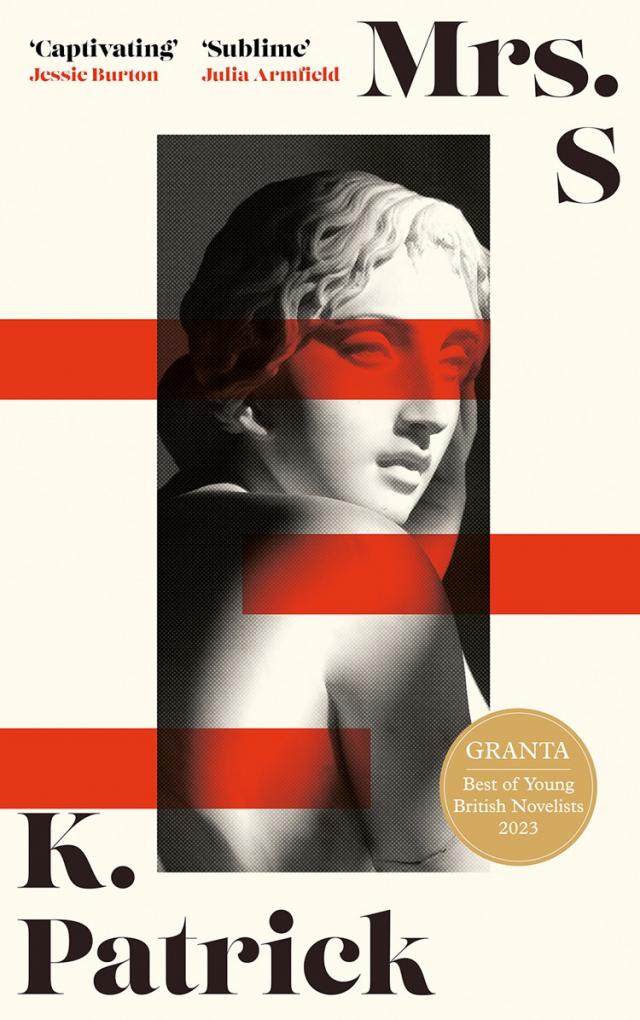
Cover design by Jo Thomson
Image © Getty Images/joelclements
Quotation by Hilda Doolittle, from Collected Poems, 1912–1944, copyright © 1982 by The Estate of Hilda Doolittle. Reprinted by permission of New Directions Publishing Corp and by permission of Carcanet Press, Manchester, UK.
A catalogue record of this book is available from the British Library
This novel is entirely a work of fiction. The names, characters and incidents portrayed in it are the work of the author’s imagination. Any resemblance to actual persons, living or dead, events or localities is entirely coincidental.
All rights reserved under International and Pan-American Copyright Conventions. By payment of the required fees, you have been granted the non-exclusive, non-transferable right to access and read the text of this e-book on-screen. No part of this text may be reproduced, transmitted, down-loaded, decompiled, reverse engineered, or stored in or introduced into any information storage and retrieval system, in any form or by any means, whether electronic or mechanical, now known or hereinafter invented, without the express written permission of HarperCollins.
Source ISBN: 9780008560997
Ebook Edition © June 2023 ISBN: 9780008561017
Version: 2023-04-24
Epigraphs
You are clear
O rose, cut in rock,
hard as the descent of hail.
I could scrape the colour
from the petals
like spilt dye from a rock.
If I could break you
I could break a tree.
If I could stir
I could break a tree –
I could break you.
H.D., ‘Garden’
You are not made by yourself, but by the thing that you want.
Fanny Howe, ‘Catholic’
Contents
Cover
Title Page
Copyright
Epigraphs
Mrs. S
About the Author
About the Publisher
Mrs. S
She argues with the gardener. Her voice is not raised. I stop to watch them. Stood opposite one another in her grand driveway, branches from a dark-green shrub in his wheelbarrow. He does not know he is being argued with, he does not know how to read the angles of her body. One foot taking aim, the other carefully sets her balance. Chin, skyward, it rips through the overhead pine tree. Her hand – I want more detail, I can’t have it – throws his gaze towards the flower beds. He lifts his shirt almost to his nipples to wipe his face. Thinks he is putting his masculinity to good use. Flashing his hard work. His bellybutton too. The size of a fingertip, refusing to be eclipsed by muscle. An unregulated softness. He is vulnerable. There is nothing he can do. Her energy is concentrated and precise, light through a magnifying glass. Left standing with his shirt balled into his fist. He pushes the wheelbarrow away, back into the garden, to face his mistake. Oh, she is vigilant, she knows she is not alone. I am discovered, I burn. Like her I stand my ground. Dare her to wave, to give that hand to me.
Miss Miss Miss. What else could I ask them to call me? Matron is the job title. Strange as it is, that might sound better, a nice word to wear. At least I could taste a little butch in it, a pair of crossed arms, a dramatic mole, a stiff back. No, Miss instead. The Girls repeat it all day long. They flirt with me, with each other, with the reverend who blushes in his long black robes. I don’t remember possessing this adolescent power. They make eye contact and hold it steady.
A bust of the dead author sits cold on a plinth. As The Girls walk in from church they dart to kiss her head, to tap her nose, to tickle her chin. The Housemistress does nothing, I do nothing. The ritual feels hard-earned. Especially in this weather. Spring flowers rotting in the cold snap. Clouds pinned to our shoulders. The Girls press chilled mouths, chilled fingertips, to the marble. I blow into my hands. When one Girl traces the dead author’s lips with her tongue, I interrupt weakly. Hey, hey. Don’t do that. Recently I’ve learned not to say please.
She emerges from her office. Mrs S, the headmaster’s wife. She prefers luxurious fabrics. Today, in honour of the unexpected frost, a cashmere polo neck. As she sees The Girls she smiles and tugs on her sleeves. Her nails are painted maroon. Last week they were bright red. Fingers have the poise of a conductor’s. Morning Ladies. Good morning, they echo. Each shifts quickly away from the dead author’s head. The Girls respect Mrs S’s beauty. She is tall. From a few feet, the closest we have been, I notice I am taller. Only just. Her face tricks me into familiarity, lifted from a painting, a feminine ideal. Cheekbones that stun. She knows it. Smiling, pulling them tighter. Surely rich like the rest of them. Her job is vague, a counsellor of sorts. She has a large office in which The Girls are invited to drink tea and talk through their weeks. I have never been inside.
The Girls shake off their blazers, the same style for over two hundred years. Rain drips onto the worn red tiles. The whole uniform is done in an awful blue. A cheapened summer sky. Tights, shirts, tie, hair ribbons, pleated heavy skirt, all blue blue blue. Mrs S stops to chat with The Girls. I catch her eye. She looks at me briefly, expectantly. Luckily a Girl needs her attention and I am freed.
The school is haunted by the smell of breakfast. I used to love breakfast. Now it has been intensified beyond pleasure. A tray of scrambled eggs leaking water. Bacon with shimmering, rubberized fat. Damp toast. Soft apples. Pears with snakeskin. I slip a banana in my pocket and leave the dining room quickly. In the staffroom I am eyed up, then largely ignored. Each year a new version of me enters the school, sent over from Australia, spoken to only when needed. What was promised to me? A visa, a true English experience, a dead author.
I surprise myself by liking the headmaster. Mr S, her husband. This morning he sweeps in, wearing that strange cloak clipped around his neck. Another bizarre tradition. Large hands, large neck. Large thighs too, I assume, if I could make them out beneath the thick pinstripe trousers. The charm of unworried men. He is taller than all of us. Mrs S, I imagine, likes this about him especially. His height he keeps friendly, stooping as he greets people. For a few seconds he stands close to me. His clothes smell clean. On his skin there is cinnamon, something woody and sweet. That big body, so well taken care of.
The women talk with him, most of the men nod. Months later and I have still not talked to many of the staff. A few were interested in my accent, in the parts of Australia I know well, which are parts they don’t know at all. Some have cousins, an aunt, an uncle living in the big cities. Their disappointment visible when I don’t recognize the streets, the surnames. The Housemistress I like enough. Like me, not often seen in the staffroom, her body stiffening whenever required to meet with another teacher. She creates a tension she does not want. The other teachers wary, unable to place her. I wait in case she appears. Sometimes after breakfast, to deliver information about The Girls who are ill, who will be spending the day in bed. Today the door is not swung open with her usual force. I am disappointed.
The bell rings. I have nowhere to be. During the week my job centres on what I have been asked to help with. A class here, an outing, a sports match. My only preoccupation is The Girls. Waking them up, moving them to school, to breakfast, to prep, to dinner, to bed. The middle of the day wanes. I sip my coffee and read the papers on other people’s desks. Marking. A holiday permission form. Two shopping lists done in sloppy handwriting. Teaching is a job I have considered. On the history teacher’s desk is a stack of thin exercise books. I open the first. Inside, one of The Girls has written answers to questions on the First World War. Number one is a list of battles and dates. Number two is a few short sentences on the perils of trench life. She overuses the word very. The conditions were very harsh, the mud very thick, the food very bad, the rats very prominent. Nostalgia confused with meaning. He has not yet given her a mark.
Over the chair is his jacket. A smell of past rain and tobacco. I hear footsteps in the corridor and step away. They fade, a door opens, and the person is released outside. I slip a hand into his pockets and find a pipe, a wallet, even a hip flask. Rain starts up again. Driving into the windows. I want to open the wallet and find what clubs he is a member of, how many bank cards, I want to see the image of his younger face on a driver’s licence. My boredom is unusual in its current cruelty. I didn’t use to be like this, I don’t think. I don’t think I used to be like this. Wind applies pressure to the building. Something is blown over on the path, skittering across the gravel. Spring’s sudden violence.
The school pretends to be a town. Within the grounds are two shops. One labelled a tuck shop that sells emergency pieces of uniform, stationery and sweets from enormous jars. The other is only books. They sit side by side, cheap units in front of the older buildings, shamed by their movability. Both are open only in the mornings. I walk across the tarmac, the weather possibly improving, momentarily calm. Heat has been promis
Lessons are happening all around me. In the main building each grand window shows a desk, or blackboard, they still use chalk. In a third mobile unit, alongside the shops, is Home Economics. The lower windows are more revealing. Pictures of the uniforms across the past one hundred years line the walls. Proudly positioned. Skirts at the ankles, the knees, back at the ankles. Straw boaters and red-piped blazers largely unchanged. The Girls sit at sewing machines, fiddling with thread, flicking little levers. A woman’s voice is loud through the open windows. She holds up a diagram. They will be making teddy bears. The Girls are an older class, I recognize a few faces. Fifteen, maybe sixteen years old. Too old, surely, for teddy bears. I think the teacher catches me watching her. I don’t move. The Girl nearest the window turns now and I involve her in my look too. A bell sounds. Class is dismissed. I leave the scene, noticing last minute the pieces of teddy bear across each desk, readied for the machines. Torsos, legs and arms in neat arrangements. Round plastic eyes. See-through bags of stuffing.
Above, the clouds begin to move fast. More rain is visible over the hills. Despite working at the school for months I have not yet visited the bookshop. The sign was obviously done by a student from years ago, the colours faded and water-stained in places. Childish drawings of books, some with faces, some in flight, pages opened as wings. Pens and pencils with large, bespectacled eyes. A display sits by the entranceway. On the table is a lace tablecloth, too large, dropping almost to the grey carpet tiles. Three books have been selected. Each covered in dust, each written by, or at least about, the dead author. The editions are not special. Two covers show a famous portrait, cheaply cropped at the chest so you cannot see her clasped hands, the odd way her fingertips press into knuckles. The other is a local scene. Grey skies, a storm whipped up by oil paint, green tremors and whorls across a fell. A biography. I flip it over and read the author’s information. She attended the school from 1981 to 1987. I imagine her work details the place in more pleasing terms than the dead author ever did.
Hi. A Girl is behind the counter. In their final year they must take turns running the shop in between study. I have little to do with them. Hi. She is hunched over a thick textbook. Looks fun. Oh it isn’t. In the margins she makes quick marks with a pencil. It is too hot, a smell of damp. In the corner an electric heater burns furiously. Postcards are for sale. More green scenery. Cardboard curled slightly. One shows a bust of the dead author’s head, the same from the hall. The photo’s contrast is too high. The wood panelling is turned almost orange, shadows built menacingly beneath her brow and chin. Can I help you at all? The Girl puts the pencil between her teeth. No, just looking. On the back wall are mostly textbooks. Maths, Physics, Biology. All the guides promise straightforward help with the more serious exams. English Literature is covered on the shelves adjacent to the counter. The Girl keeps the pencil between her teeth, not quite biting but rolling it back and forth. I pull down Shelley, Keats, Wordsworth. So you’re the latest Matron? Stupidly I feel my cheeks flush. Yes. The one from Australia? That’s me.
She imitates an Australian accent as she says Australia, dragging the vowels. It is surprisingly accurate. Not bad. Thank you. The Girl closes her book, tucking her pencil within its spine. So what are you doing here? She leans across the counter. Working. Yeh, but why? I have family nearby. This is a sudden, strange lie. Oh right. But its quick dullness works. Her line of questioning comes to a halt. Yeh still you must miss the weather. The pencil is picked up again. And the beaches oh I can’t even imagine the beaches. Ah well I lived inland, not many beaches, a lake maybe. Maybe? I mean yes, a lake.
The book is opened again. Well, I’d like to visit one day who knows, could even be next year. I am still holding the Wordsworth. You should, it’s a nice place, Australia. Did you want to get that? I put the book back on the shelf. No, thanks, no. OK. She takes up her mark-making again, the margin filling sporadically. Hello, hello, isn’t it busy, rush hour. Mrs S shakes rain from an umbrella. Yes. The Girl stands suddenly. I feel my own back straighten. She nods at me. A handsome coat. Ghastly, that weather comes out of nowhere. Rain has curled, then glossed, the fine hair at her temples. I imagine her, suddenly, as a very serious child. I look down, embarrassed for her, for me.
Neither I nor The Girl offer a response. Mrs S does not seem to expect one. I believe you have a book for me. Oh? The Girl is panicked briefly, searching under and around the counter. This! She is triumphant. Indeed. It is a large package. Hardback, too big, too ostentatious for fiction. Thank you. In front of us both she unwraps it. She is not careful. The painted fingernails don’t seek the folded edge but instead tear straight through the middle. Wonderful, yes, this is the one. It is a book on roses. Second-hand, the cover image a garish trellis.
I am disappointed, had found myself hoping for something that might give more of her away. Not a gardener, then? I have let my disappointment show. Her eyes are on me, body adjusted slightly, elbows sharp. I could be, I want to say, I could be a gardener. Instead, I shrug my shoulders. No not really. The shrug is wrong, indifferent. I feel as though she looks at my throat, just where it leaves the collarbone, ridge into tendon. My fingers find the source and I touch a mound of bone as if it were the knot of a tie. I suppose it isn’t for everyone, gardening. She doesn’t smile.
And how about you? She moves away from my throat. The Girl doesn’t shrug. I haven’t tried, not properly, I helped my mum plant some herbs last year but they all died. Well that’s a shame, perhaps not enough sun. She tucks the book under that sharp elbow. Thank you. She casts the farewell into the shop. I wait as long as I can bear. A few more books picked up and put down. The Wordsworth once more, daffodils on daffodils. You sure I can’t help you with something mate? The teasing is harsher. No, thank you, I’m all good. No problem.
The Girl doesn’t look up as I leave. The weather is changed again. Sun hits the back of my neck. Wet tarmac releases its scent like a flower. Mrs S walks slowly, back straight. She is always like this. Her elegance is second nature. She follows the wide path past the science block, the main building to her left. Below is the crooked B-road that runs past the school’s entrance to the few farms scattered in the fells’ cradle. Clouds now thinned across the roofs, treetops. I follow her. A spy. She has already opened the book, turning pages, looking up intermittently to stay her course. There she is, a child again.
Ahead is the church, then the path that leads past her residence, over the river, towards the boarding houses. Not once does her stride break over the uneven surface. As she reaches the church she slows. A miniature twist of her neck. Does she know she is being followed? I can’t believe I am following her. I can’t turn around. I can’t believe I am following her. If I turn around, if I go back to the school, then she will know my intention.
I keep walking, faster now, building into a story of heading back to my own room. In the distance the school bell sounds again. Now she turns around. In the middle of the road she faces me. Shocked into silence I stare. Did I forget something? Pardon? In the shop, did I leave something in the shop. Oh, no, I’m just going back to my room. I point, with a slight shake, at the church, trying to indicate a beyond. Well then. The book remains open, pressed against her hip, pinned by her forearm. Well then, walk with me. OK. We move into the sun. Here, take this for a sec. She hands me the book and removes her jacket. Each sleeve is folded over. On one wrist is a simple silver bracelet. I look further. Two rings. One a plain gold wedding band, the other an engagement ring, sapphires. She strides. I match her pace, continuing to hold the book. How are you finding it here? Oh you know, nice, everyone is very nice. Nice? I can’t read her steadiness. I can’t read her at all. That is, I realize, the point.
Yes, nice. I hope nice isn’t the best we can do. The we is the school, the setting, each building, every girl, all teachers, the dead author. Nice is fine! Oh, now fine? Finally, she laughs. This is me, but you already know that. We stop at the long driveway. The Old Vicarage is positioned to best enjoy the river. From the entrance it is not visible, but audible, speeding up before the descent under the bridge. Must be a nice view, not nice, I mean soothing. I point at the top left window, which would look down onto it. It is, very soothing. I hand her the book. Oh, yes, the damn roses. Her manner seems purposefully old-fashioned. An old accent is faint in the background of certain words. She continues. The house, this place, it has a great collection of roses, and I don’t know the first thing about roses, well I’m learning. She lifts the book and it slides from her grasp, spread open against the wet cobblestones. I try and fail to understand how I’ve managed to catch her off guard. She bends her knees to pick it up, bracelet slipping. Gardening, gardening I know. But roses? Roses are so. I catch her arm to steady her. Nice, I finish. Exactly. There is dirt on her hand. Using her skirt she wipes it clean.









