Dust of far suns, p.1
Dust of Far Suns, page 1


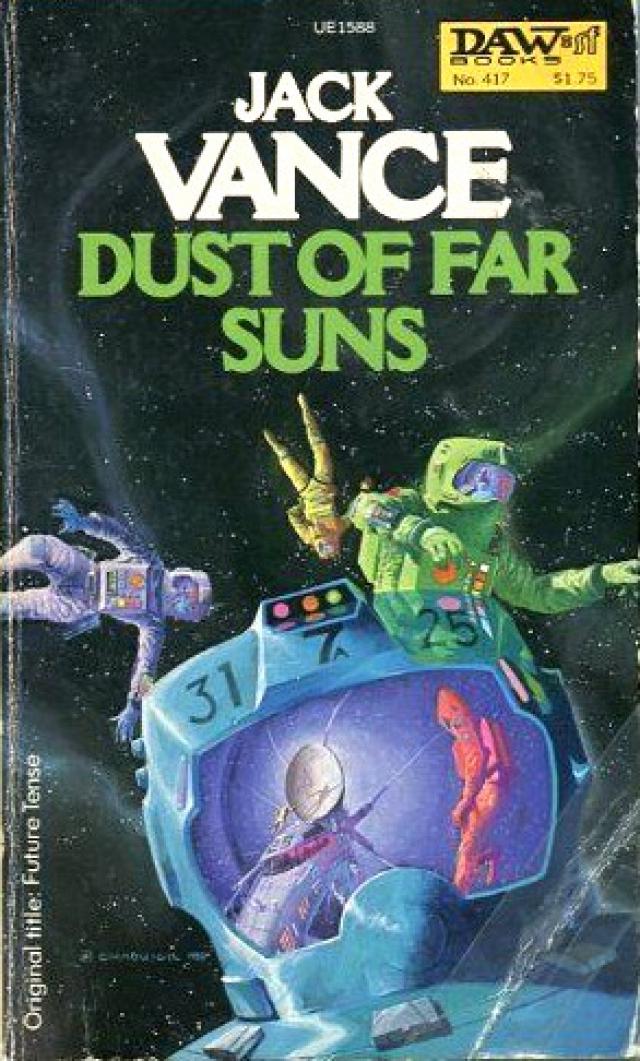
A short story collection by one of SF's greatest authors, Jack Vance.
Contains:-
Dust of Far Suns (1962)
Dodkin's Job (1959)
Ullward's Retreat (1958)
The Gift of Gab (1955)
THE DUST OF
FAR SUNS
JACK VANCE
DAW BOOKS , INC .
donald a. wollheim, publisher
1301 Avenue of the Americas New York, N.Y. 10019
Copyright ©, 1964, by Jack Vance. All Rights Reserved.
Cover art by Paul Chadwick.
ACKNOWLEDGMENTS:
The Gift of Gab, © 1955, by Street & Smith Publications. Inc.
Dust of Far Suns, © 1962, as Sail 25, by Ziff-Davis Publishing Co.
Ullward’s Retreat, © 1958, by Galaxy Publishing Corp.
Dodkin’s Job, © 1959, by Street & Smith Publications,
Inc. By arrangement with the author.
FIRST DAW PRINTING, JANUARY 1981
1 2 3 4 5 6 7 8 9
DAW TRADEMARK REGISTERED U.S. PAT. OFF.
MARCA REGISTRADA,
HECHO EN U.S.A.
Table of Contents
DUST OF FAR SUNS
DODKINS JOB
ULLWARD’S RETREAT
THE GIFT OF GAB
DUST OF FAR SUNS
I
Henry Belt came limping into the conference room, mounted the dais, settled himself at the desk. He looked once around the room: a swift bright glance which, focusing nowhere, treated the eight young men who faced him to an almost insulting disinterest. He reached in his pocket, brought forth a pencil and a flat red book, which he placed on the desk. The eight young men watched in absolute silence. They were much alike: healthy, clean, smart, their expressions identically alert and wary. Each had heard legends of Henry Belt, each had formed his private plans and private determinations.
Henry Belt seemed a man of a different species. His face was broad, flat, roped with cartilage and muscle, with skin the color and texture of bacon rind. Coarse white grizzle covered his scalp, his eyes were crafty slits, his nose a misshapen lump. His shoulders were massive, his legs short and gnarled.
“First of all,” said Henry Belt, with a gap-toothed grin, “I’ll make it clear that I don’t expect you to like me. If you do I’ll be surprised and displeased. It will mean that I haven’t pushed you hard enough.”
He leaned back in his chair, surveyed the silent group. “You’ve heard stories about me. Why haven’t they kicked me out of the service? Incorrigible, arrogant, dangerous Henry Belt. Drunken Henry Belt. (The last of course is slander. Henry Belt has never been drunk in his life.) Why do they tolerate me? For one simple reason: out of necessity. No one wants to take on this kind of job. Only a man like Henry Belt can stand up to it: year after year in space, with nothing to look at but a half-dozen round-faced young scrubs. He takes them out, he brings them back. Not all of them, and not all of those who come back are spacemen today. But they’ll all cross the street when they see him coming. Henry Belt? you say. They’ll turn pale or go red. None of them will smile. Some of them are high-placed now. They could kick me loose if they chose. Ask them why they don’t. Henry Belt is a terror, they’ll tell you. He’s wicked, he’s a tyrant. Cruel as an axe, fickle as a woman. But a voyage with Henry Belt blows the foam off the beer. He’s ruined many a man, he’s killed a few, but those that come out of it are proud to say, I trained with Henry Belt!
“Another thing you may hear: Henry Belt has luck. But don’t pay any heed. Luck runs out. You’ll be my thirteenth class, and that’s unlucky. I’ve taken out seventy-two young sprats, no different from yourselves; I’ve come back twelve times: which is partly Henry Belt and partly luck. The voyages average about two years long: how can a man stand it? There’s only one who could: Henry Belt. I’ve got more space-time than any man alive, and now I’ll tell you a secret: this is my last time out. I’m starting to wake up at night to strange visions. After this class I’ll quit. I hope you lads aren’t superstitious. A white-eyed woman told me that I’d die in space. She told me other things and they’ve all come true. We’ll get to know each other well. And you’ll be wondering on what basis I make my recommendations. Am I objective and fair? Do I put aside personal animosity? Naturally there won’t be any friendship. Well, here’s my system. I keep a red book. Here it is. I’ll put your names down right now. You, sir?”
“I’m Cadet Lewis Lynch, sir.”
“You?”
“Edward Culpepper, sir.”
“Marcus Verona, sir.”
“Vidal Weske, sir.”
“Marvin McGrath, sir.”
“Barry Ostrander, sir.”
“Clyde von Gluck, sir.”
“Joseph Sutton, sir.”
Henry Belt wrote the names in the red book. “This is the system. When you do something to annoy me, I mark you down demerits. At the end of the voyage I total these demerits, add a few here and there for luck, and am so guided. I’m sure nothing could be clearer than this. What annoys me? Ah, that’s a question which is hard to answer. If you talk too much: demerits. If you’re surly and taciturn: demerits. If you slouch and laze and dog the dirty work: demerits. If you’re overzealous and forever scuttling about: demerits. Obsequiousness: demerits. Truculence: demerits. If you sing and whistle: demerits. If you’re a stolid bloody bore: demerits. You can see that the line is hard to draw. Here’s a hint which can save you many marks. I don’t like gossip, especially when it concerns myself. I’m a sensitive man, and I open my red book fast when I think I’m being insulted.” Henry Belt once more leaned back in his chair. “Any questions?”
No one spoke.
Henry Belt nodded. “Wise. Best not to flaunt your ignorance so early in the game. In response to the thought passing through each of your skulls, I do not think of myself as God. But you may do so, if you choose. And this—” he held up the red book “—you may regard as the Syncretic Compendium. Very well. Any questions?”
“Yes, sir,” said Culpepper.
“Speak, sir.”
“Any objection to alcoholic beverages aboard ship, sir?”
“For the cadets, yes indeed. I concede that the water must be carried in any event, that the organic compounds present may be reconstituted, but unluckily the bottles weigh far too much.”
“I understand, sir.”
Henry Belt rose to his feet. “One last word. Have I mentioned that I run a tight ship? When I say jump, I expect every one of you to jump. This is dangerous work, of course. I don’t guarantee your safety. Far from it, especially since we are assigned to old 25, which should have been broken up long ago. There are eight of you present. Only six cadets will make the voyage. Before the week is over I will make the appropriate notifications. Any more questions?…Very well, then. Cheerio.” Limping on his thin legs as if his feet hurt, Henry Belt departed into the back passage.
For a moment or two there was silence. Then von Gluck said in a soft voice, “My gracious.”
“He’s a tyrannical lunatic,” grumbled Weske. “I’ve never heard anything like it! Megalomania!”
“Easy,” said Culpepper. “Remember, no gossiping.”
“Bah!” muttered McGrath. “This is a free country. I’ll damn well say what I like.”
Weske rose to his feet. “A wonder somebody hasn’t killed him.”
“I wouldn’t want to try it,” said Culpepper. “He looks tough.” He made a gesture, stood up, brow furrowed in thought. Then he went to look along the passageway into which Henry Belt had made his departure. There, pressed to the wall, stood Henry Belt. “Yes, sir,” said Culpepper suavely. “I forgot to inquire when you wanted us to convene again.”
Henry Belt returned to the rostrum. “Now is as good a time as any.” He took his seat, opened his red book. “You, Mr. von Gluck, made the remark, ‘My gracious’ in an offensive tone of voice. One demerit. You, Mr. Weske, employed the terms ’tyrannical lunatic’ and ‘megalomania’ in reference to myself. Three demerits. Mr. McGrath, you observed that freedom of speech is the official doctrine of this country. It is a theory which right now we have no time to explore, but I believe that the statement in its present context carries an overtone of insubordination. One demerit, Mr. Culpepper, your imperturbable complacence irritates me. I prefer that you display more uncertainty, or even uneasiness.”
“Sorry, sir.”
“However, you took occasion to remind your colleagues of my rule, and so I will not mark you down.”
“Thank you, sir.”
Henry Belt leaned back in the chair, stared at the ceiling. “Listen closely, as I do not care to repeat myself. Take notes if you wish. Topic: Solar Sails, Theory and Practice thereof. Material with which you should already be familiar, but which I will repeat in order to avoid ambiguity.
“First, why bother with the sail, when nuclear-jet ships are faster, more dependable, more direct, safer, and easier to navigate? The answer is threefold. First, a sail is not a bad way to move heavy cargo slowly but cheaply through space. Secondly, the range of the sail is unlimited, since we employ the mechanical pressure of light for thrust, and therefore need carry neither propulsive machinery, material to be ejected, nor energy source. The solar sail is much lighter than its nuclear-powered counterpart, and may carry a larger complement of men in a larger hull. Thirdly, to train a man for space there is no better instrument than the handling of a sail. The computer naturally calculates sail cant and plots the course; in fact, without the computer we’d be dead ducks.
“There are two types of sails: pure and composite. The first relies on solar energy exclusively, the second carries a secondary power source. We have been assigned Number 25, which is the first sort. It consists of a hull, a large parabolic reflector which serves as radar and radio antenna, as well as reflector for the power generator; and the sail itself. The pressure of radiation, of course, is extremely slight—on the order of an ounce per acre at this distance from the sun. Necessarily the sail must be extremely large and extremely light. We use a fluoro-siliconic film a tenth of a mil in gauge, fogged with lithium to the state of opacity. I believe the layer of lithium is about a thousand two hundred molecules thick. Such a foil weighs about four tons to the square mile. It is fitted to a hoop of thin-walled tubing, from which mono-crystalline iron cords lead to the hull.
“We try to achieve a weight factor of six tons to the square mile, which produces an acceleration of between g/100 and g/1000 depending on proximity to the sun, angle of cant, circumsolar orbital speed, reflectivity of surface. These accelerations seem minute, but calculation shows them to be cumulatively enormous. G/100 yields a velocity increment of 800 miles per hour every hour, 18,000 miles per hour each day, or five miles per second each day. At this rate interplanetary distances are readily negotiable—with proper manipulation of the sail, I need hardly say.
“The virtues of the sail, “I’ve mentioned. It is cheap to build and cheap to operate. If requires neither fuel nor ejectant. As it travels through space, the great area captures various ions, which may be expelled in the plasma jet powered by the parabolic reflector, which adds another increment to the acceleration.
“The disadvantages of the sail are those of the glider or sailing ship, in that we must use natural forces with great precision and delicacy.
“There is no particular limit to the size of the sail. On 25 we use about four square miles of sail. For the present voyage we will install a new sail, as the old is well-worn and eroded.
“That will be all for today.” Once more Henry Belt limped down from the dais and out the passage. On this occasion there were no comments.
II
The eight cadets shared a dormitory, attended classes together, ate at the same table in the mess hall. In various shops and laboratories they assembled, disassembled—and reassembled computers, pumps, generators, gyro-platforms, star-trackers, communication gear. “It’s not enough to be clever with your hands,” said Henry Belt. “Dexterity is not enough. Resourcefulness, creativity, the ability to make successful improvisations—these are more important. We’ll test you out.” And presently each of the cadets was introduced into a room on the floor of which lay a great heap of mingled housings, wires, flexes, gears, components of a dozen varieties of mechanism. “This is a twenty-six hour test,” said Henry Belt. “Each of you has an identical set of components and supplies. There shall be no exchange of parts or information between you. Those whom I suspect of this fault will be dropped from the class, without recommendation. What I want you to build is, first, one standard Aminex Mark 9 Computer. Second, a servomechanism to orient a mass ten kilograms toward Mu Hercules. Why Mu Hercules?”
“Because, sir, the solar system moves in the direction of Mu Hercules, and we thereby avoid parallax error. Negligible though it may be, sir.”
“The final comment smacks of frivolity, Mr. McGrath, which serves only to distract the attention of those who are trying to take careful notes of my instructions. One demerit.”
“Sorry, sir. I merely intended to express my awareness that for many practical purposes such a degree of accuracy is unnecessary.”
“That idea, cadet, is sufficiently elemental that it need not be labored. I appreciate brevity and precision.”
“Yes, sir.”
“Thirdly, from these materials, assemble a communication system, operating on one hundred watts, which will permit two-way conversation between Tycho Base and Phobos, at whatever frequency you deem suitable.”
The cadets started in identical fashion by sorting the material into various piles, then calibrating and checking the test instruments. Achievement thereafter was disparate. Culpepper and von Gluck, diagnosing the test as partly one of mechanical ingenuity and partly ordeal by frustration, failed to become excited when several indispensable components proved either to be missing or inoperative, and carried each project as far as immediately feasible. McGrath and Weske, beginning with the computer, were reduced to rage and random action. Lynch and Sutton worked doggedly at the computer, Verona at the communication system.
Culpepper alone managed to complete one of the instruments, by the process of sawing, polishing and cementing together sections of two broken crystals into a crude, inefficient but operative maser unit.
The day after this test McGrath and Weske disappeared from the dormitory, whether by their own volition or notification from Henry Belt no one ever knew.
The test was followed by weekend leave. Cadet Lynch, attending a cocktail party, found himself in conversation with a Lieutenant-Colonel Trenchard, who shook his head pityingly to hear that Lynch was training with Henry Belt.
“I was up with Old Horrors myself. I tell you it’s a miracle we ever got back. Belt was drunk two-thirds of the voyage.”
“How does he escape court-martial?” asked Lynch.
“Very simple. All the top men seem to have trained under Henry Belt. Naturally they hate his guts but they all take a perverse pride in the fact. And maybe they hope that someday a cadet will take him apart.”
“Has any ever tried?”
“Oh yes. I took a swing at Henry once. I was lucky to escape with a broken collarbone and two sprained ankles. If you come back alive, you’ll stand a good chance of reaching the top.”
The next evening Henry Belt passed the word. “Next Tuesday morning we go up. We’ll be gone several months.”
On Tuesday morning the cadets took their places in the angel-wagon. Henry Belt presently appeared. The pilot readied for takeoff.
“Hold your hats. On the count…” The projectile thrust against the earth, strained, rose, went streaking up into the sky. An hour later the pilot pointed. “There’s your boat. Old 25. And 39 right beside it, just in from space.”
Henry Belt stared aghast from the port. “What’s been done to the ship? The decoration? The red? The white? The yellow? The checkerboard.”
“Thank some idiot of a landlubber,” said the pilot. “The word came to pretty the old boats for a junket of congressmen.”
Henry Belt turned to the cadets. “Observe this foolishness. It is the result of vanity and ignorance. We will be occupied several days removing the paint.”
They drifted close below the two sails: No. 39 just down from space, spare and polished beside the bedizened structure of No. 25. In 39’s exit port a group of men waited, their gear floating at the end of cords.
“Observe those men,” said Henry Belt. “They are jaunty. They have been on a pleasant outing around the planet Mars. They are poorly trained. When you gentlemen return you will be haggard and desperate and well trained. Now, gentlemen, clamp your helmets, and we will proceed.”
The helmets were secured. Henry Belt’s voice came by radio. “Lynch, Ostrander will remain here to discharge cargo. Verona, Culpepper, yon Gluck, Sutton, leap with cords to the ship; ferry across the cargo, stow it in the proper hatches.”
Henry Belt took charge of his personal cargo, which consisted of several large cases. He eased them out into space, clipped on lines, thrust them toward 25, leapt after. Pulling himself and the cases to the entrance port, he disappeared within.
Discharge of cargo was effected. The crew from 39 transferred to the carrier, which thereupon swung down and away, thrust itself dwindling back toward earth.