Imperial vengence, p.1
Imperial Vengence, page 1


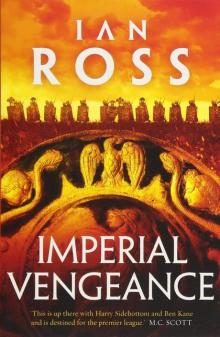
IMPERIAL VENGEANCE
Ian Ross
Start Reading
About this Book
About the Author
Table of Contents
www.headofzeus.com
About Imperial Vengeance
Aurelius Castus is one of the leading military commanders of an empire riven by civil war. As the emperor Constantine grows ever more ruthless in his pursuit of power, Castus fears that the world he knows is slipping away.
On the eve of the war’s final campaign, Castus discovers that the emperor’s son Crispus aims to depose his father and restore the old ways of Rome.
Castus must choose between honour and survival, and face a final confrontation with the most powerful man in the Roman world, the ruler he has sworn loyally to serve: the emperor Constantine himself.
Contents
Welcome Page
About Imperial Vengeance
Epigraph
Map
Historical Note
Prologue
Pannonia, April ad 323
Part 1: Four Months Later
Chapter 1: Germania, August ad 323
Chapter 2
Chapter 3
Chapter 4
Chapter 5
Chapter 6
Chapter 7
Chapter 8
Part 2
Chapter 9: Thessalonica, June ad 324
Chapter 10
Chapter 11
Chapter 12
Chapter 13
Chapter 14
Chapter 15
Chapter 16
Chapter 17
Chapter 18
Chapter 19
Chapter 20
Chapter 21
Part 3 Eighteen Months Later
Chapter 22: Constantinople, March ad 326
Chapter 23
Chapter 24
Chapter 25
Chapter 26
Chapter 27
Chapter 28
Chapter 29
Chapter 30
Epilogue
Author’s Note
About Ian Ross
About the Twilight of Empire series
From the Editor of this Book
An Invitation from the Publisher
Copyright
Ipse audiam omnia; ipse cognoscam et se fuerit comprobatum, ipse me vindicabo.
I myself will hear everything; I myself will judge. And if it is proven, I myself will avenge.
Emperor Constantine, Codex Theodosianus
Map
Historical Note
After a decade of civil war, the Roman world remains divided between two rival emperors. Constantine controls Rome itself and the western provinces, while Licinius rules Thrace, the east and Egypt. For now, a fragile truce holds between them.
Both men have promoted their sons to be Caesars – junior emperors. In the west, Constantine’s eldest son Crispus rules in Gaul. Aided by capable military commanders, he has already won a series of victories against the barbarians beyond the Rhine. Loved by the troops and the citizens of the provinces, the young man’s prestige and influence grows.
But all know that Constantine and Licinius are ambitious for sole power, and their mutual hostility must soon ignite once again into open war. The prize of battle will be supreme mastery of the Roman Empire.
Prologue
Pannonia, April AD 323
Fausta was trying not to listen to the screams of the burning men.
Smoke wreathed the three pyres on the riverbank, shot through with spitting flames, and the victims bound to the upright stakes were almost obscured. From the raised imperial tribunal where Fausta was sitting, two hundred paces from the execution ground, the screams sounded almost like the cries of scavenging birds. The smoke rose, three long black smudges against the grey sky, and streamed away across the Danube.
‘How long does it usually take them to die?’ Fausta asked. She inhaled slowly, nervously, wondering if she might catch the reek of roasting flesh. She thought of the rich meal she had eaten earlier, and her stomach tightened. But all she could make out was the familiar aroma of woodsmoke.
‘It depends on the construction of the pyre, domina,’ said Rutilius Palladius, the primicerius of the Corps of Notaries. ‘Sometimes death can take an hour, sometimes much longer…’
‘Too much green wood on those pyres,’ the emperor broke in loudly. ‘They’ll choke on the fumes before the flames kill them.’ He stifled a cough, and pressed his jaw down against his chest.
Fausta glanced at her husband. Constantine sat in a high-backed ivory chair, his heavy jaw sternly set, his muscular face in profile looking more than usually hawkish. His deep-set eyes glared at the distant pyres, and he held a gold cup of wine in one hand, balanced on the arm of his throne. Fausta wondered if he was already slightly drunk. He wore a plain brown soldier’s cloak flung around his shoulders, covering his embroidered tunic and mantle; he had picked up a cold during his campaign against the barbarians earlier in the spring.
‘But perhaps, majesty,’ one of the eunuchs said lightly, ‘this is not a display suited to ladies?’
Constantine snorted, as if the idea amused him, then rolled his head to glance at Fausta. He smiled sourly. ‘My wife is made of stronger stuff than most,’ he declared.
Fausta merely nodded, sitting upright on her cushioned chair. In fact she found the sight of the pyres slightly revolting. She had never enjoyed the spectacle of death, not even the sight of gladiators in the arena or criminals being mauled by beasts, which most people seemed to find so entertaining. Burning in particular unnerved her; she had recurring nightmares of death by fire, or of being roasted or suffocated in an oven. But she was determined not to show any sign of weakness.
‘So she may be, but I am not,’ said the old woman beside her, gathering her white mantle around her bony shoulders. Fausta and Helena, her mother-in-law, were seated close together, as if they were the best of friends. ‘At my age such things are not to my taste.’
Hypocrite, Fausta thought. She had seen the relish on the woman’s face as the prisoners were led out and bound to the stakes, and the fires lit beneath them.
‘But perhaps you enjoy the sight, Fausta dear?’ Helena asked in a cold dry whisper, leaning closer still so no others could hear. ‘Don’t the gods you worship – the demons, I should say – enjoy burnt offerings? They eat the smoke as their sustenance, isn’t that right?’
Fausta turned to meet the old woman’s creased brown face and flinty gaze. Helena’s voice still carried the sibilant accent of her native Bithynia. She was an innkeeper’s daughter, raised from the dung of the stables by Constantine’s father. How old was she anyway, Fausta thought with distaste, seventy, eighty? Why wasn’t she dead?
With the embroidered silk hem of her shawl Fausta covered her lips. ‘At least my gods do not murder their own sons,’ she whispered, and managed a smile.
Helena grinned tightly, and a spark of light winked from her eye. To anyone watching, the two women would appear to be sharing a private joke. ‘Perhaps you should try living on smoke yourself for a while?’ Helena said, laying a thin hand on Fausta’s sleeve. Her fingers tightened to a pinch. ‘You are looking somewhat plump these days!’
Fausta’s smile was a glazed mask. She refused to rise to the bait.
The emperor’s mother had first appeared at court only a year or two previously. Since her arrival in the palace, Flavia Julia Helena had insinuated herself into the emperor’s confidence. She was a Christian too, of course, even more fanatical in her piety than Constantine himself. She had surrounded herself with priests and religious teachers, and had built a personal retinue, a court within the court, of officials and eunuchs who wished for her patronage and the access she could grant them to her son’s favour.
Fausta had never managed anything as clever. Her marriage to Constantine might not be happy, but at least it was stable. She had given him three children so far, and he allowed her considerable freedom. But now she had been outflanked, and her hatred of Helena was all the purer for being reciprocated. Decades before, Constantine’s father had divorced Helena to marry Fausta’s own much older half-sister; now the old woman was determined to wreak a long cold vengeance for that insult, and she was savouring every moment of it.
‘Well, I will leave you to your amusements, my dear,’ the old woman said, then got up, pausing to distribute a few low-value coins to the attendants. Fausta did not turn to watch her depart. She suppressed a shudder of loathing.
Down on the riverbank the pyres were burning more fiercely; Fausta could hear the snap and hiss as the flames rose. If she narrowed her eyes the fires resembled torches, raised against the great grey barbarian wilderness on the far side of the river. A cold sweat was forming on her brow as the familiar night terrors filled her mind. She tried not to think of the bursting flesh, the charring bones.
‘Remind me,’ she asked in a loud steady voice, ‘what crimes those men have committed?’
‘Remind her, Palladius,’ the emperor said in a weary tone.
‘They have been found guilty of conspiring with the barbarians in their recent depredations, domina,’ Palladius said. ‘Two of them are decurions of the towns of Gorsium and Margum, while the third is the sub-prefect of the Pannonian river fleet. Our Augustus, in his sacred wisdom, has decreed that anyone found to have collaborated with barbarians, or shared in the plunder of their infamous attacks, should suffer death by fire. A ruling perfectly in keeping with the traditional ancestral virtue of the Roman peopl
‘I see,’ Fausta replied. She frowned lightly; it often amused her to feign the sort of simplicity expected of women in these matters. There was nothing very traditional about the execution method, she knew; crucifixion would have been usual once, but these days nailing people to crosses was thought problematic by those of the Christian faith.
‘And these barbarians would be the Sarmatians that my glorious husband defeated in battle last month? The ones led by… Rampsy Mondus?’
‘Rausimodus, domina,’ Palladius said, with a condescending shrug. ‘The Goths and Sarmatians, yes. The guilty men conspired to allow them across our border, and shared in the spoils of their pillaging. For that they must be punished!’
‘No doubt my brother in the east had a hand in it too,’ Constantine said from his throne. ‘At least one of them was in the pay of Licinius, maybe all three. Weakening our frontiers works to his benefit. Those smoke trails are a clear enough message to him, I’d say.’ He waved his cup in the direction of the pyres.
‘And now he claims that our troops violated his borders in pursuing the barbarian filth,’ Palladius said, his voice rising in outrage. ‘He claims that we seized provisions from citizens within his domains!’
‘If Licinius wants another war,’ the emperor declared gravely, ‘he can have one. On my terms.’
The assembled men – military officers, ministers and secretaries – gave a collective rumble of agreement.
Fausta gazed at the burning pyres, and thought about guilt, about punishment. She had never believed in justice; life was dictated by chance, and by struggle. Everywhere the weak and the innocent suffered while the powerful and unscrupulous grew wealthy. If the gods existed, they were too divinely content to care. But Fausta understood power. The power of men, at least: she had been surrounded by it since she was born. Both her father and her brother had been emperors, until Constantine had ended their lives. Now her husband was the greatest emperor of them all.
Casting her gaze across the scene in front of her, she took in the gorgeously patterned tunics of the courtiers and the ministers, the cordon of white-uniformed Protectores standing around the tribunal, the ranks of household troops beyond, the eagles of the Lanciarii and the Third and Sixth Herculia legions, and the banners of the horse guard units. Even here, with the executions in progress, there was a crowd of petitioners waiting to speak to the emperor, to assail him with their pleas. And beyond them all, the three pyres still sending their smoke up towards the clouds. All of it was a demonstration of her husband’s power: a power so immense that he could cause those who displeased him to die screaming in the flames.
Yes, Fausta understood power. She understood vengeance too, and that at least she could believe in. Staring at the pyres, she wondered idly who the victims might be, if she had the power to dictate these things.
First, of course, would be Helena. Fausta did not think of herself as a malicious person, but it gave her a sharp satisfaction to imagine the old woman perishing in the blaze. No doubt Helena would return the compliment, if she ever got the chance.
The second pyre, though, would be reserved for Flavius Julius Crispus, Fausta’s stepson. That thought gave her less pleasure. Crispus was her husband’s eldest child, by an earlier union of dubious legitimacy, but he was his father’s pride. Six years had passed since Constantine made Crispus Caesar and sent him off to govern the western provinces, and in that time the fame of the young hero had spread throughout the empire. Crispus had smashed the invading army of the Franks on the plains of northern Gaul, campaigned across the Rhine against the Alamannic tribes, forced treaties of submission or alliance on almost all the Germanic peoples of the frontier, and returned the west to peace and prosperity. And he was just twenty years old.
Twenty. Fausta herself was only a decade older. She was closer in age to Crispus than to her husband, who was over fifty now. She remembered the wedding at Serdica two years before, when Crispus had returned, triumphant, from his victories on the Rhine to marry some plain little grand-niece of Helena’s. That too had been the old woman’s doing; another tactical move. Once the boy had been a gangling spot-faced adolescent, but when Fausta saw him at Serdica he had looked like a young god, so gloriously handsome it was disturbing.
And now he had a wife, and that wife had already given him a son of his own. Crispus was the anointed successor to the throne, and when that day came Fausta and her own children would be left dangerously isolated. Helena would have her victory.
Fausta had already made several covert attempts to end the young man’s career, and his life. Those attempts had failed. Vainly she had wished that some Frankish spear, some Alamannic javelin, might rid her of her young rival. But he was still alive, back in Gaul and flourishing. In fact, Fausta knew that most of Crispus’s victories were the work of his military officers: her eunuch, Luxorius, maintained a very efficient intelligence network. But the young Caesar took all the credit, of course.
No, Crispus might be a hero, and a divinely beautiful one too, but he was still her adversary and a danger to her and her children. The enemy of my blood; she must destroy him.
And who should die on the third pyre? Fausta considered the question, raising her hand to her mouth and biting at the carnelian ring she wore on her smallest finger. One of those military officers that had made Crispus such a success, perhaps? She only knew the name of one: Aurelius Castus. For a moment she placed him there, in the heart of the fire.
But she had known Castus, long before, and although many years had passed since she last saw him, she still thought of the man as an ally. Perhaps, in a strange way, as something approaching a friend. He could be useful to her, at least. No – the third pyre would not be for him.
She was distracted from her fantasy by two men riding up from the execution ground towards the tribunal. They had been the ones supervising the burnings; both of them wore the belts and insignia of the agentes in rebus. They dismounted and approached the emperor, the cordon of guards parting before them. One was a bow-legged, balding man with a dour expression and a stubbly black beard. The other was younger, blond and curly-haired; he could almost have been handsome, Fausta thought, were it not for the fixed intensity of his gaze and the smirk that flickered across his face like a nervous tic.
The younger agent bowed as he stepped up to the tribunal, then knelt.
‘Majesty,’ he announced, ‘the sentences have been carried out. All three guilty men confessed their crimes before the end. They begged your sacred mercy that their families should be spared a like punishment.’
He glanced up as he spoke, and Fausta caught the gleam of enthusiasm in the man’s eyes. Just for a moment she pictured children burning, and cold nausea rose in her throat.
‘They shall be spared,’ Constantine said, with a lazy circling motion of his hand, then turned to Palladius. ‘Reward these men for their exemplary service,’ he told the official.
The two agents backed away, with a slight air of disappointment. Fausta fought down her repulsion. The third pyre, she thought – the third pyre should be for the smirking executioner himself.
But the man had only been following orders. He was a tool, an appendage of a greater power. It was her husband Constantine who had ordered the deaths and watched as the sentences were carried out. Just as it had been Constantine who decreed the deaths of Fausta’s own father and brother, years before.
The third pyre, surely, was for her husband.
Just for a moment, a heartbeat, the thrill of that thought illuminated Fausta’s mind. Then the fear gripped her, a sense of horror so deep she clenched her back teeth. She felt the pulse quicken in her throat; if anyone had even guessed that she had these thoughts… Enough, she told herself. She banished her treasonous fantasies.
She was tired, weary of this imperial cavalcade. Soon it would all be over, and they would travel the twenty miles south to the palace at Sirmium. The thought of a hot bath was almost overwhelmingly pleasant. Would the emperor come to her bed again that night? He often did, after returning from campaign. Fausta felt no pleasure at the prospect. She was almost certain that she was pregnant again; over a year had passed since the birth of her last child, her daughter Constantina. And this was her role in life, she thought: a mill for producing imperial offspring…