Dirty boulevard, p.1
Dirty Boulevard, page 1
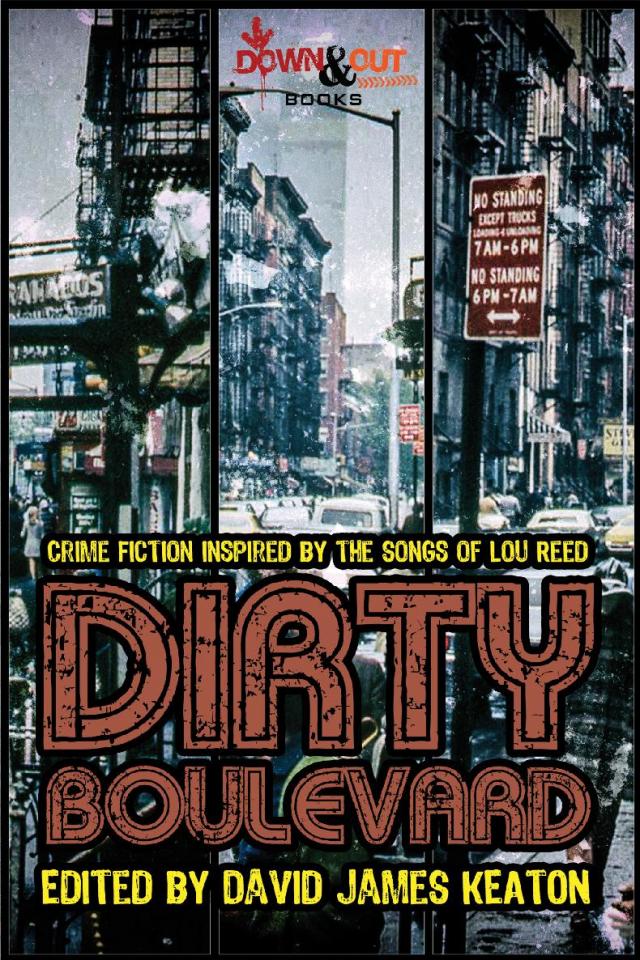


DIRTY BOULEVARD
Crime Fiction Inspired by the Songs of Lou Reed
David James Keaton, Editor
Compilation Copyright © 2018 David James Keaton
Story Copyrights © 2018 by Individual Authors
All rights reserved. No part of the book may be reproduced in any form or by any electronic or mechanical means, including information storage and retrieval systems, without permission in writing from the publisher, except by a reviewer who may quote brief passages in a review.
Down & Out Books
3959 Van Dyke Road, Suite 265
Lutz, FL 33558
DownAndOutBooks.com
The characters and events in this book are fictitious. Any similarity to real persons, living or dead, is coincidental and not intended by the author.
Cover design by JT Lindroos
Visit the Down & Out Books website to sign up for our monthly newsletter and we’ll deliver the latest news on our upcoming titles, sale books, Down & Out authors on the net, and more!
TABLE OF CONTENTS
Dirty Boulevard
Foreword: First Second Story Story
Patrick Wensink
Preface: Second Second Story Story
David James Keaton
Jesus’ Stepson
Reed Farrel Coleman
Sister Ray
Alison Gaylin
I’ll Be Your Mirror
Eryk Pruitt
Satellite of Love
J. David Osborne
Pale Blue Eyes
Cate Holahan
The Last Great Native American Whale
Gabino Iglesias
Perfect Day
Ross E. Lockhart
Street Hassle
Lee Matthew Goldberg
Andy’s Chest
Tony McMillen
The Power of Positive Drinking
Rusty Barnes
Black Angel Death Song
Erin Keaton
Coney Island Baby
Richard Neer
I’m Waiting for the Man
Chris Orlet
Ladies Pay
Rob Pierce
Endless Bicycle
David James Keaton
Ride into the Sun
Jonathan Ashley
Acknowledgments
About the Contributors
Preview from The Getaway List by Frank Zafiro and Eric Beetner
Preview from Presiding Over the Damned by Liam Sweeny
Preview from Broken Windows by Paul D. Marks
For Jon Ashley
&
By(e) Jon Ashley
Foreword:
FIRST SECOND STORY STORY
Patrick Wensink
Dirty Boulevard was originally conceived by Jon Ashley. If you never met him, Jon was a great writer, a madman, and a very troubled soul. He was also a Kentuckian to the bone—so much so that his parents gave him the middle name “Downs” after Churchill Downs, where they supposedly fell in love. That’s about as fitting a handle as one can give Jon, at once a little poetic and a little seedy.
To our great sadness, Jon passed away in 2017 before he could finish compiling and editing this book. I thank David James Keaton for taking over the reins. His work was a labor of love and respect for our mutual friend. Oddly, I first met David at Jon Ashley’s bookstore, Second Story Books.
But, then again, oddity was the norm at Second Story.
It’s as a bookstore owner that Jon Ashley will always be remembered in my world. Second Story was like High Fidelity, but for books. But High Fidelity with a credit card machine always on the fritz and a feeling that the whole place was all going to fall apart at any moment.
Second Story was located in a converted white house off of the hip Bardstown Road area of Louisville. It was a large room with a set of stairs leading to an open air loft apartment above, where Jon lived. The center of the store was not dominated by bestseller racks or staff picks, but by a hangout space made up of couches and chairs rescued from back alleys. Stacks of books were everywhere and in no particular order. It was not uncommon to find Cormac McCarthy layered atop a plumbing how-to manual atop a volume of Jacques Derrida, with a full ashtray of butts atop that. Jon smoked like a truck that was bleeding oil across the engine block. The books I bought from Jon still smell like Marlboros.
Smoking in the store was a bad idea, but Jon was always full of bad business ideas like that, which was partially why I admired him so much. Jon Ashley lived entirely in his own world. He was tall, and his long dirty blond hair always framed his round face. Depending on the day, that face either looked like he just woke up in the alley or like it was his birthday. You never knew which Jon you were going to get when you walked into Second Story, and you never knew what kind of chaos you would find inside.
Once, I saw the butt end of a pistol peeking out from the couch cushions.
“Hey, Jon, is that a gun?” I said. “Oh yeah, check this out!” he excitedly began waving it around. “I found it in a dumpster. It’s a BB gun.”
When I mentioned that customers might be a little freaked out by that, he shrugged and said something to the effect of, “That’s their problem.”
That’s their problem seems to have been not only Jon’s business philosophy, but maybe his life philosophy. Shortly after I became friendly with Jon, he and his pal Paul were gathered around a computer looking up Nazi memorabilia in plain sight for all customers to see. When I asked the obvious question, Jon responded with wide eyes and his gravelly voice, “This is a good test to see if you’re cool or not.” They continued their conversation while flashing through several images of books and weapons embossed with swastikas. When I didn’t run for it, Jon finally explained that Paul had purchased a Nazi Boy Scout manual at a yard sale, and they were seeing if it was worth any money.
If I was weirded out by this research, that was my problem. Whenever I mentioned that customers just slinked out of the store while Jon was having a shouting argument with his father, he never seemed concerned. That was their problem. When two college students complained that Jon’s tiny white dog had taken a shit directly in front of the poetry section, he seemed in no great hurry to clean it up. I once organized a reading at Jon’s shop for myself, Scott McClanahan, and Sam Pink, during which he ran out and left me in charge of the store, despite the fact that the credit card machine was busted again and I had no petty cash or any idea how to run a bookstore.
It was their problem until it was his problem, financially. I don’t know exactly how long Second Story was in business, but it couldn’t have been more than a year or two. Jon had an MFA in creative writing and was working on his first crime novel, The Cost of Doing Business, on top of battling personal and substance issues. This did not lend itself to running a balance sheet with much precision. When I did some publicity work to promote a reading at the shop by crime writer Charlie Newton, Jon had no money to pay me and instead traded me books by Madison Smart Bell and Ross MacDonald. I was a lot more forgiving than a landlord, though.
It was also not uncommon for the CLOSED sign to be facing outward during normal business hours. And it was not uncommon to see the sandwich board on the sidewalk and the OPEN sign showing, but the door locked.
I kept returning to Second Story for weeks after it abruptly closed, simply assuming Jon was sleeping in when I came to call.
The last purchase I made was a copy of Fredrick Exley’s A Fan’s Notes. Jon told me this story of alcoholism and mental illness and failing to meet the American Dream was one of his favorites. Less than a week after taking it home, Jon phoned to ask if he could borrow the book. He said he was going through a dark time and it would be helpful. I returned A Fan’s Notes to the man who sold it to me and never saw it again.
I hope Exley’s novel brought Jon some comfort when he needed it. He was a man who deserved comfort and happiness and success, but never seemed to find it. His writing career began to blossom after closing Second Story and moving across the state to Lexington. We spoke on the phone sporadically, and I gathered that this was a move aimed at getting himself out of the destructive cycles of his hometown. He published two crime novels about a used bookstore owner named Jon and his sidekick Paul, who get mixed up in the heroin trade, and a Western novel set in 1800s Kentucky that Jerry Stahl praised by saying, “Ashley has a strong, savage, uncompromising voice of his own.”
I only knew the last years of Jon’s life over the phone. We tried meeting up for coffee, but those plans always fell through. He was in and out of rehab during this time, and when his wedding engagement was broken off, he was absolutely crushed. I always had huge hopes for Jon and his writing. Last we spoke, he was writing an article about the horrific state of rehab in Kentucky. I am convinced he is the only person who could have done the topic justice with his blend of writing chops and first-person suffering. Sadly, he died before that piece saw the light of day.
I am sad that Jon’s exposé on the rehab system will never be published. I am sad that I will never get another wild, rambling phone call out of the blue from Jon’s Kentucky phone number. Even though I find the irony fantastic, I am still sad that Second Story Books is now a portrait studio for baby photos.
Please enjoy Dirty Boulevard: a book that meant so much to one of the most original real-life characters anyone has ever met.
And if you don’t, that’s your problem.
Back to TOC
Prefac e:
SECOND SECOND STORY STORY
David James Keaton
When I met Jon Ashley, I’d just moved from Pittsburgh to Louisville, and he’d submitted a short story to a magazine I was running, then quickly followed up with an invite to catch a reading at his bookstore, Second Story Books, which turned out to be only two streets over from my new apartment. At first glance, this bookshop was pretty sketchy, with surprisingly few actual books, the kinda place that screamed “front” until you looked closer and realized he simply cultivated a ragged, eclectic selection that was likely just his own library of favorites, sort of like the daydream I’d have to one day open a video store with my own movies, as long as no one ever touched them.
But his pulp paperbacks were well-handled, just as pulp paperbacks should be, as was the store with its peeling paint, cracked window, no visible cash register, and a moldy Rorschach-test of a carpet that seemed to tailor-made to be cut into squares to transport the mysterious stains directly to the state crime lab.
At the reading, I don’t remember seeing any chairs, just a yard-sale couch or two, but I do remember sitting on the floor in a funky corner and author Scott McClanahan weaving around in a Serpico-looking leather jacket, screaming his trademarked brand of heartbreaking redneck fiction at a decent crowd, pausing only to pass out some brownies, which I don’t think were spiked. Some other hot, young writers read their stories, too, buncha hipsters that I don’t remember much about what they were shouting, except maybe for Patrick Wensink, who looked a bit like the Joker’s accountant, or maybe more like that one particularly well-dressed gang member in Return of the Living Dead (seriously, go look, back seat of “Suicide’s” convertible, on the far right, spitting image). Pat actually took a second to warn me that anything I might see in this venue was just “business as usual.” But maybe I couldn’t pay attention to the readings because I couldn’t take my eyes off of Jon Ashley and his big blazer, sleeves rolled up like it was still the eighties, his floppy, blond hair which orbited the gravely bark of a seventy-five-year-old chain smoker. I gawked as Jon would listen to about three minutes at a time of any particular reading, and then crash through the door, bell jingling, to pace outside, yelling into his phone while he held one hand over his ear. I assumed he was in the middle of a breakup or something, which would certainly make sense considering later, when he was working on this anthology, he would routinely message me updates about Lou Reed songs and how much they spoke to him, as well as this project he was putting together, peppering those bulletins with asides like, “Hold on, I need to leave this party before I slit some dude’s throat.”
Eventually, I would understand that he would be outside making some sort of deal, not the supernatural selling of souls that would justify that level of passion and sidewalk stomping, but more than likely a more typical sort of deal, the oldest story in the book, really, a theory that no longer seemed far-fetched at all when his debut novel came out and his protagonist was revealed to be a misanthropic writer named, you guessed it, “Jon,” who owned a renegade little bookstore called “Second Story,” which also happened to be a front for the largest heroin racket in Kentucky. Either way, break-up or drug deal, someone was disappointing him out there on the sidewalk, and with him I got the feeling they were both interchangeable.
So, when the readings were over and I was giving up trying to find prices on something to take home with me and just taking everything in and marveling at how quickly I’d discovered a legitimately exciting writing scene smack dab in the middle of this new town, Jon noticed me for the first time and swooped over to shake hands. He said in that alarming, throaty rumble of his, “Hey, did you read that story I sent you?” and I started mumbling that I was sorry I hadn’t had a chance to read it but yet, but was looking forward to checking it out…and he held up a hand and said: “Shhhhhh, just go ahead and publish it.” Then he laughed and slapped my arm and said, “Just kidding.” But he wasn’t, of course. And I never got a chance to read that story back then. I would have gotten around to it as I’d promised, maybe even published it, if my magazine hadn’t gone under, but then Jon’s bookstore went under, and then Jon went under, too, so here I am five years later pulling his story out of a forgotten slush pile and, of course, as I’m sitting here right now and reading it for the first time, it’s perfect for this book after all, a book that was originally his, which, in another tragic twist, will now funnel all its profits to a suicide prevention charity instead of Jon’s vices. And since I’ve taken over this project and remain unburdened by unwritten rules regarding editors putting their own stories in anthologies they’ve compiled…his story is included in this book, too, right alongside my own, the new editor, because my hypocrisy knows no bounds!
But most importantly, this means I will have done exactly what he told me to do the day I met him, right before he slapped my arm and crashed out that front door of Second Story Books, pacing the sidewalk on his cell phone, where someone was disappointing him all over again.
We’ll miss you, Jon. I don’t think you would have been disappointed with how your book turned out.
Back to TOC
JESUS’ STEPSON
Reed Farrel Coleman
You’re thinking of Campbell’s soup, gliding through Alphabet City, maniacally laughing, walking west to the Hudson just because you are. Because maybe you can beg a hit over there from someone whose bridge you haven’t yet burned or to blow a sorrier fucker than yourself on the West Street pier for a few bucks to score. You know what you’re laughing at, and it’s not that funny. What is? Nothing. Not anymore. You pass by a pretentious shithole art gallery, and you’re thinking that Andy Warhol is a fraud because he wears that stupid fucking bleached blond wig and because he takes other people’s hard work and makes jokes of it and reaps millions from the jokes and he’s the only one laughing. Well, you’re laughing, too, but not at the same joke. You hear your own sick laughter and ask yourself: Is that a laugh or the name of a laugh? Who asks that? Who thinks that?
You do. You think it. And you think Warhol’s a scumbag because he keeps the millions and yanks everybody’s chain and they call him a genius for sucking the nectar out of everyone else’s fruit. You think he’s the frail personification of the American dream. You stood next to him at a Factory party once, a long time ago, in another lifetime, before he was shot by that crazy chick. You find yourself wishing the prick would have died, and you remember thinking that he smelled like girl sweat and cold breakfast sausages and that he seemed brittle. Brittle as a sparrow with hollow little bird bones that could snap like the minted toothpicks from the Chinese takeout on East 1st Street. You’re thinking about General Tso’s chicken. You’re thinking about Andy Warhol and General Tso’s chicken and a million other things, everything and anything because you’re trying so hard not to think about the one thing at the center of the universe. You’re hurting—bones to hair, inside out. You’re sick. You’re cold. So much snot runs out of your laughing nose that Aqualung’s got nothing on you. You need to get healthy, but you haven’t seen healthy since, since…you can’t recall. Health isn’t even an option for you any longer. You’ve just got to get both feet out of the grave you’re digging for yourself. You remember your dad’s eternal quest at the Garden City Country Club to shoot one round under par. One round, just one fucking round and I would die happy. And then you think about General Tso and a tap in birdie putt and Warhol giving a decorous golf clap and shouting, “Well struck. Well struck, General Tso.” And in the midst of your laughter, you picture your dad’s envy at the General and smile at knowing Dad never did and never will shoot under par. You’re just like your dad. Par isn’t an option for either of you, not anymore. You’re a smelly skeleton, with stringy hair plastered to your scalp by the rain, and the rain is as close as you’ve come to a shower in weeks. You think of Molly and how she was once all you thought about. About how beautiful she was with her purple black hair and green eyes flecked in gold and how just tasting her made you hard as a rock. Now Molly is a green-eyed afterthought. Not even. She’s an afterthought of an afterthought, a lump of flesh, a thing holed up in an East Village squat with no running water or heat, an object that moves its mouth who you sometimes relate to when she scores and shares with you. She doesn’t make you hard anymore because she smells worse than you and the only thing you want a taste of comes in a folded packet. Off-white powder cooked up with water-like caramel in the maw of a bent spoon and sucked into the tip of a needle through a piece of dirty cotton. And while you’re laughing and thinking about Napoleon in rags and General Tso and Daddy and how Molly used to taste and how you once had it in you to get hard and you realize that there is some comfort in having your world shrunken into a singularity. You remember that you once cared about other things and that there were things to care about and people to care about. You worried about what was happening to the planet and your friends being fed into the meat grinder in Nam and burnt up napalm babies and punji sticks and black pajamas with straw hats. You heard the thwacking of Huey gunship rotor blades beating the air. You cared about the energy crisis and dollar gas and long lines. You cried for Sharon Tate, prayed for Patti Hearst, and wanted a blue ’67 GTO more than life itself. You were a jumble. You listened to the Nightbird’s voice and jerked off as she read poetry and played King Crimson and the Moody Blues, “Breathe deep the gathering gloom…” Life was too complicated before it was about one thing and one thing only. Now that other stuff is all nothing, forgotten commentary, a waste of time, not even a memory, really. Everything is about one thing: scoring. Only heroin makes you feel like a man anymore, more than a man. You just have to ease that needle into the only worthy veins you’ve got left in your hollow, stinking body, the ones between your unwashed toes. All it takes is that pin prick to see the Savior’s face and to feel his cloudy arms around you and, like in the Lou Reed song, you feel just like Jesus’ son. But just now you’re maniacally laughing because you’re not Jesus’ son but his ugly stepson, the forgotten one, the abandoned one stuffed in a suitcase with a plastic bag taped around its head and tossed out of the boat into the East River in the dark. Now that you’re tapped out and had borrowed every dime anyone would ever lend you, bummed every nickel a smelly junky could and torn down every line of communication between you and your family—they won’t even take your calls or let you in the house anymore because…well, let’s face it, there’s only so many times your mom’s gonna let you steal her earrings. She has only so many pairs to steal, after all. And when your mother gives up on you, you know you’re fucked, royally and every other way there is to be fucked. So what else is there to do but laugh?