Jacob, p.1
Jacob, page 1


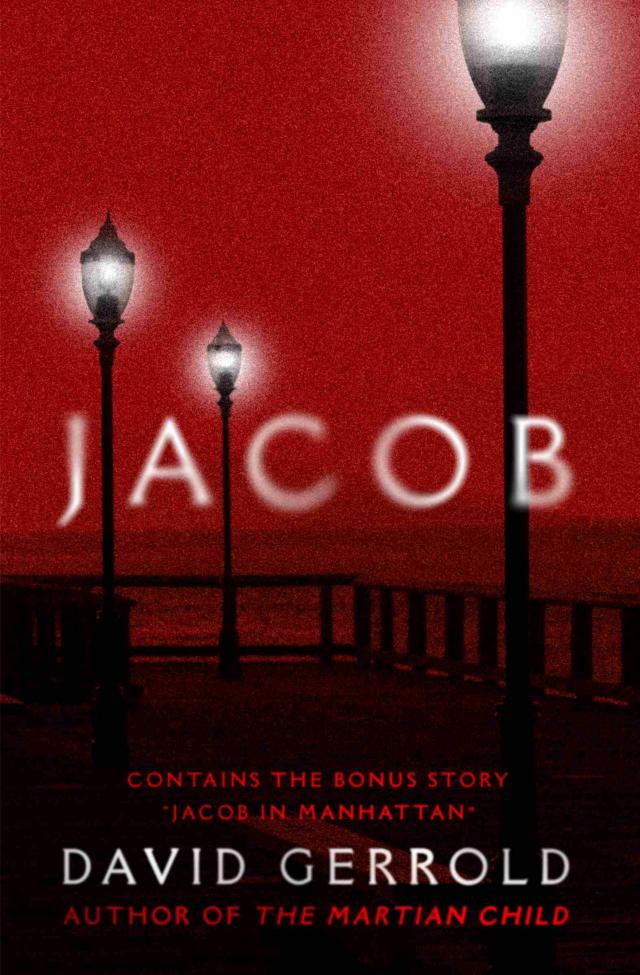
Jacob
David Gerrold
Contents
Introduction
Monsieur
Jacob in Boston
Jacob in Seattle
Jacob in San Francisco
Jacob in New Orleans
Bonus: Jacob in Manhattan
About the Author
Introduction
I blame The Magazine of Fantasy & Science Fiction.
It is the one of the longest-lived and most consistently excellent magazine in the genre—and that’s a very high bar in a genre that has also produced Astounding/Analog, Galaxy Science Fiction, and Asimov’s.
But yes, I blame F&SF.
In November of 2014, the magazine published a story called “A Guide to the Fruits of Hawai’i” by Alaya Dawn Johnson.
It was fucking brilliant. (And that’s an understatement.)
It was a different kind of vampire story, and I’m not going to spoil it by saying anything more about it here. Go look it up. It won the Nebula Award from the Science Fiction Writers of America, and it’s available in The Year’s Best Science Fiction & Fantasy, 2015.
If I ever had any complaint about the story, it was the best kind of complaint. I wanted more. I wanted it to go on. I wanted it to be the first part of a glorious novel. But there was just this one tale. And it lurked in my head for weeks—because it left me with so many unanswered questions. I wanted to know more about that world, how it worked, and who were the people who lived there?
That was not where Jacob started, but it is where the impulse began.
This is how imagination works. Imagination is not about creating something out of nothing.
Imagination is what happens when the mind starts wondering about possibilities and probabilities—it’s what happens when the mind starts asking, “What else? What if? If this were possible, how would it happen? And why? Who would benefit? Who would hurt? What would it feel like? What would that world feel like?”
Ideas trigger ideas in a surprising chain reaction, sometimes even an avalanche. Sometimes it’s “I didn’t know that was possible,” and sometimes it’s “Oh, I want more of that,” and sometimes it’s simply, “Wait a minute, that suggests this—”
All of writing, in my never humble opinion, comes out of the festering stew of experience that bubbles just behind the writer’s immediate consciousness.
I shall elucidate.
I like a good scary story, not as a steady diet, but as a pungent surprise. And while I am not specifically a horror writer, I have written a few horrific tales, some of them intentionally. Back in the last century, I even wrote a vampire script called Nightsiders.
Oh, that was fun. Let me tell you about that.
The first time we showed it around to producers and studios, they told us, “Nobody’s making vampire movies anymore. It’s a dead market. We’re looking for something different.” (I don’t think they intended the pun, but who knows?)
The second time we showed the script to producers and studios, they told us, “There are already too many vampire movies out there. We don’t want to compete. We’re looking for something different.”
I rolled my eyes so hard I saw the bottom of my brain. It was murky and tangled up there.
Because Nightsiders was different.
In that script (which I may someday turn into a novel, because it’s a pretty good story) vampirism isn’t a supernatural condition, it’s a medical condition, a blood infection. The story is about two young men accidentally infected and how they’re pursued by the community of nightsiders who see them as a threat to their secrecy, and meanwhile the Centers for Disease Control has a super-secret agency pursuing the nightsiders’ community, so they can stop the blood-infection from spreading.
Curiously, in that script, the word “vampire” is never mentioned.
And then there were those movies, which I will not discuss or mention here. Let’s just skip over them.
Oh, hell. I will say that.
From the vampire’s point of view, human beings are ephemeral. From a vampire’s point of view, most human beings are uninteresting. I mean, think about it, why would an immortal creature find an eighteen-year-old girl attractive? She’s immature, unfinished, naïve. For real companionship, wouldn’t a vampire want someone with enough life experience, knowledge, and insight to be interesting enough for some serious conversations about art and music and literature and life?
I would much rather mention Anne Rice’s work. In 1978, she published a terrific book, Interview with a Vampire. The hero was Lestat, an unashamedly charismatic monster. The book was a unique best-seller and ultimately spawned The Vampire Chronicles series, which explored the vampire experience as a supernatural event. Eventually, she traced it all the way back to ancient Egypt. What a great read.
While I have never considered myself a major fan of vampire stories, I am occasionally fascinated by the transformative aspects of becoming a bloodsucking undead predator. So all of this (and more) churned around in my head for a while, occasionally bubbling to the surface like a belch from the shark in Jaws. Or maybe a fart. Does anyone know? Do sharks fart? I think it’s probably a buoyancy issue—but that’s how my mind works. I keep thinking about weird things and then I wonder about the engineering.
And that’s how I started thinking again about vampires. The day-to-day mechanics of a vampire’s existence.
If a vampire is super-sensitive to sunlight, then who brings in the mail? Who takes out the trash? Who answers the doorbell when the Jehovah’s Witnesses come knocking?
A vampire needs a daykeeper, someone to take care of all the daylight errands. It might not be so critical in today’s world, when a good internet connection is all you need, but still—someone has to run daytime errands. And in the past, before the electric age began, a daykeeper would have been essential. That’s where this started. I wrote the first part, “Monsieur,” as a novella. In it, a young writer, Joseph, has a different kind of interview with a vampire.
I sold the story to then-editor Charlie Finlay at The Magazine of Fantasy & Science Fiction. I kept thinking about young Jacob, spent some time researching Seattle in the mid-1800s and wrote a sequel. Charlie passed on it, he didn’t want to start a series in the magazine. Not a problem. By then I had been (you should pardon the expression) sucked into Jacob’s story. “Jacob in Seattle,” “Jacob in Boston,” “Jacob in San Francisco,” and finally “Jacob in New Orleans.” All of those tales have been assembled into this novel. They tell much of Jacob’s history as a daykeeper and eventually as a vampire.
But … I wasn’t through with Jacob. Or perhaps he wasn’t through with me. He arrived in the 20th century in “Jacob in Manhattan.” This one might very well be the single most disturbing story I have ever written. It is not for the squeamish. It is horrific. And this is the only warning you’re going to get.
Perhaps there are other tales to tell in the further adventures of Joseph and Jacob. But after Manhattan, I might be better off not. Of all the creatures in science fiction, fantasy, and horror (three overlapping genres), vampires are the most seductive.
If there is anything out there more dangerous or more attractive, I’m not sure I want to know.
David Gerrold, 2023
Monsieur
Dark returns and I am awake.
The first few hours, I keep to myself, as usual. Since the invention of electricity, since the invention of gaslight, since the invention of candles and oil lamps, since the invention of fire, humans have rolled back the dark.
Not a problem. The first few hours, I keep to myself, listening.
The dark is filled with noise now.
Not so long ago, I could lie still and alone, drinking in the sounds of the world, crickets ticking away the heat of the day, owls questioning the darkness, and sometimes the skittering of tiny feet in the woodwork. Now, no. Instead, all the different voices, both silent and raised, sometimes quietly intense, more often screeching insanities—underneath it all, the distant howling of machines, everywhere tinny attempts at music as if to drown out all the other noises.
And the dark is filled with light as well, prowling fingers of light like the yellow eyes of huge black beasts. Cruising through hardened shadows, glaring at the dark around, they leave trails of acrid stench.
But the dark is my world, not theirs. Eventually, the beasts return to their caves, they slumber. The dark grows still again and I am free to walk the streets alone, tasting the air.
Sometimes, sometimes, long years of sometimes, I lie alone in silence, lost in dreamtime.
And sometimes I awake, curious again, hungry again. I move through darkness alone, a shadow within shadows.
And finally sometimes, I seek out those last uncertain pools of life, those three-in-the-morning lonely outposts, the last diner or gas station on a lonely road, standing brave against the pressing dark.
I seek the gatherings of those who circle the glare. Like moths, they sparkle only for an instant, then fly toward the light—they crackle into smoke and disappear.
The pages work their way around the group and finally back to me. Mark and Larry nod their approval. Janice purses her lips, frowning over a phrase that bothers her, she’ll come back to it later. Her scrawny little brother utters the inevitable, “Real vampires don’t sparkle,” as if it’s his own sudden profound insight. Everybody ignores him.
&nbs p; Jerome is the one who’s actually been published—therefore he has credential—sucks at his coffee. “I like the rhythm. It sets a mood.”
A couple others chime in with half-formed ideas, nothing useful, and I realize what I’m missing is the acknowledgment that the piece works. No one has actually said, “This is good. I want to read more.”
And in that moment, I realize how much I hate writers’ workshops.
We don’t want honest criticism, that might hurt—what we really want is a standing ovation and a gold trophy shoved into our hands. But we don’t give honest criticism either, because we don’t want to be cruel. We don’t want to lose our friends. So we all just play patty cake with each other’s bullshit and pretend we’re real writers.
Camellia—not her real name, but the one she writes under—usually goes through each manuscript like a third grade teacher correcting punctuation. Her prose is methodically precise, perfectly bland. She grabs for the parsley and misses the meat and potatoes.
Jerome sits, he types, he sells. There’s no secret to it, he says. Just sit, just type. He has a genius level IQ and the social skills of a hyperactive beagle. But it’s not arrogance, it’s enthusiasm, getting that award nomination for that first short story was the first time he ever got validated for anything. He finally has a piece of evidence that he’s good at something. Self-esteem issues die hard. When you’re small and smart in high school, you don’t get girls, you get swirlies. If you’re gay, you don’t get girls either.
Patty writes fan fiction. That’s the polite phrase. She doesn’t bring pages to the meetings anymore. And she won’t upload anything to the Facebook group either. Most of her stories end up with Kirk and Spock professing their undying love for each other. Sometimes one is hurt and the other comforts him. Sometimes they end up in bed, sharing the most embarrassing pillow talk before fucking each other’s brains out. Larry was unimpressed, he told her bluntly, “Star Trek is about reaching for the stars, not your vibrator.” She hasn’t spoken to him since. Occasionally, however, she still argues that everything is fan fiction. She justifies that notion, arguing that all writers are reworking personal fantasies into their stories.
Jerome says that women writing about male-male sex isn’t much different than men fantasizing about lesbians. Maybe that’s the point. What Patty writes is for herself, not anyone else. And if that’s true, then Larry is right as well. Me—I’m not going there anymore. It’s argument without end.
Michael is working on an epic. He hasn’t shared any of it. Mostly, he sits and grunts and offers insights that he borrowed from “the big guys.” Michael has read every book on writing he can find. He wants to be perfect, he wants to write the greatest book ever. He’s been working on his epic since middle school. His claim to fame is a letter he received from the editor of a major magazine. He submitted his fifty page outline. The editor wrote back, “You should learn how to lance a boil before you attempt brain surgery.”
Michael waves the letter around as if it’s a validation. The editor wrote back. A personal note. No one has had the heart to tell him he’s had his legs cut off at the ankle with one of the most elegant cheap shots since Mark Twain (allegedly) said, “I did not attend the funeral but I sent a nice letter saying I approved of it.”
Gil and Emma always come together, but they’re not a couple. Gil rides a motorcycle, so he dresses in leather, Emma wears skirts over jeans. Is that some kind of a statement or does she have the fashion sense of a Republican? Maybe she’s transgender, nobody is sure, nobody is impolite enough to ask—but she has a feminist mission. Does it pass the Bechdel test? Is there unconscious sexism in the structure of the story or the way the characters are presented? Does it challenge the bubble of white male privilege or does it reinforce the patriarchy? Her stories aren’t narratives as much as they’re screeds about how the world would be better off without men. One day, Larry is going to punch her. And that will prove she’s right about men and violence. It’s not that anyone disagrees with her militancy, we wouldn’t dare anyway—it’s just that she can’t talk about anything else.
Gil doesn’t write. He comments. He annotates. He informs. He explains. He deconstructs. He is erudite. And that’s why nothing in the world satisfies him. He only sees what’s wrong. That’s why no one will go to the movies with him. You come out laughing and joyous—“That was fun!”—and Gil will immediately begin speaking in that intense manner of his, explaining how the filmmakers conned us, manipulated us, and ultimately cheated us. Too often, he’s right. And after he’s through, you don’t know if you want to punch Michael Bay or Steven Spielberg or Jar Jar Abrams. Or just Gil. Behind his back, Larry calls him, “Mister Buzzkill.”
Oh, and Blaze—why do women choose such silly names for themselves? Blaze is a dithering idiot. Not my words, Larry’s. She’s short, she’s fat, and she loves to pretend she’s a profound thinker. She speaks in that meticulous fannish way, halfway between Asperger’s and booorrrring, annotating aloud every meticulous detail of the minutiae of her existence. Today she pretends she’s a writer. Next week, she’ll pretend to be an artist. The week after that, I don’t know yet—but eventually she’ll cycle back to pretending she’s a writer. We had to ask her not to bring her guitar—that was when she was pretending to be a filker. She sings almost as well as she plays. She knows two chords.
Me? I’m the guy who … I don’t know. I’m still trying to figure it all out.
I want to be the guy who takes this business serious. At least, that’s the way I see myself in my own personal movie. That means I’m the quiet shy guy. The listener. The observer. How others see me? I’m the spear-carrier, sometimes the sidekick, sometimes the comic relief, in their movies.
That also means I’m that guy—you know, the one that everyone else explains things to, so the audience will get it. They see me as the stupid one. I am surrounded by self-appointed explainers.
In the movie, when you need some necessary exposition, there’s always Murray-The-Explainer. He’s an archetype, like Morgan Freeman always plays The-Magic-Negro. He’s usually a scientist, more often a computer nerd who types fast, sometimes a specialist of some kind, like a paleontologist or an expert in epidemiology.
Murray-The-Explainer is never the hero. He’s always scenery. In my case, all those Murrays are also a lot of useless and annoying noise. There was a time when I appreciated the attention. Now, no. So I’ve learned how to smile and nod.
Maybe I’m being arrogant—
No, there’s no maybe at all in that. I am arrogant. I have to be to be a writer. Whatsisname, that guy who spoke at the college last month—he said writing is arrogant. You have to be at the very top of the arrogance ladder to believe that what you write is so important that trees should be chopped down.
“What about those of us who only publish eBooks?”
“Even more so—you’re burning coal to create electricity. You’re contributing to the heat-death of the planet. That’s even more arrogant.”
So yeah, okay. I’m arrogant. Arrogant enough to have a derogatory opinion of dilettantes and dabblers, doodlers and dawdlers, and especially the danglers who don’t do anything useful at all, just hang on like dingleberries. And every bit as useful. They suck the energy out of the room. I take this shit serious. If I’m going to kill a tree—or a planet—I had damn well better make sure it’s worth it.
It’s not just about putting words on paper—not anymore anyway. Mostly they’re marks on a screen. The last time I printed something out, it was a term project. But it’s not about the words, it’s about the thought pictures, the moment, the mood, the feelings, the experience. It’s time-telepathy. A storyteller takes something out of his head and puts it in yours. It can’t just be to entertain—it also has to enlighten.
And that’s really the bottom line. Who the hell am I to enlighten anyone else? I can barely boil a cup of ramen.
In my existential moods, I ask myself why? Why is any of this important? Why am I spending all this effort? Why? Just why am I doing this?
Because it’s a great way to be with people without having to be with people—?