Roman roulette, p.1
Roman Roulette, page 1


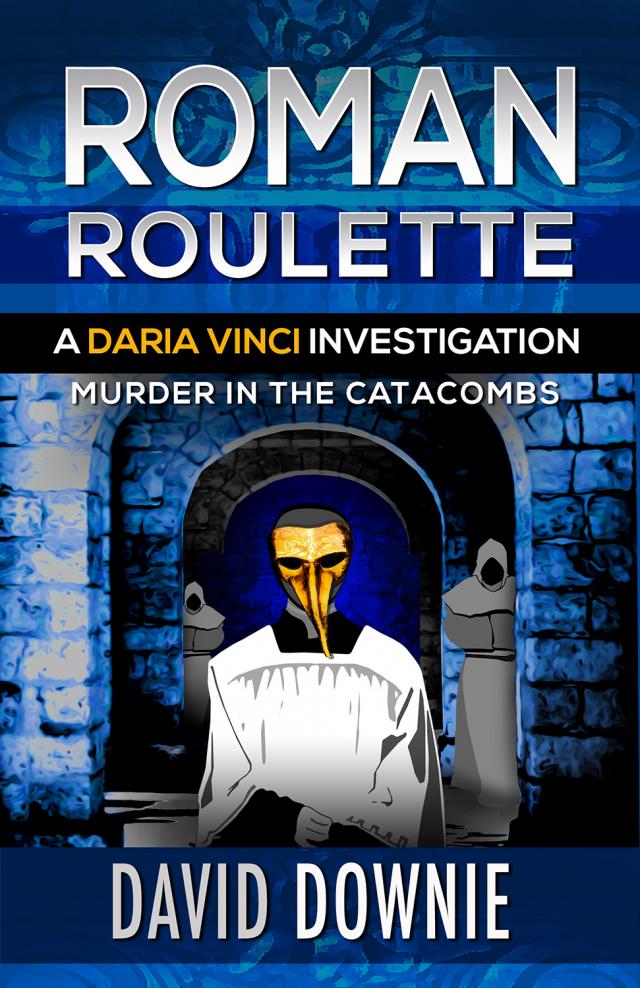
ROMAN ROULETTE
A Daria Vinci Investigation
Murder in the Catacombs
David Downie
Alan Squire Publishing
Bethesda, Maryland
Roman Roulette is published by Alan Squire Publishing, Bethesda, MD, an imprint of the Santa Fe Writers Project.
© 2022 David Downie
This is a work of fiction. Names, characters, businesses, places, events, locales, and incidents are either the products of the author’s imagination or used in a fictitious manner. Any resemblance to actual persons, living or dead, or actual events is purely coincidental.
All rights reserved. Except for brief passages quoted in newspaper, magazine, online, radio, or television reviews, no part of this book may be reproduced in any form or by any means, electronic or mechanical, including photocopying or recording, or by any information storage and retrieval system, without permission in writing from the publisher (www.AlanSquirePublishing.com).
Printed in the United States of America.
ISBN (print): 978-1-942892-32-8
ISBN (epub): 978-1-942892-33-5
Library of Congress Control Number: 2022938587
Jacket design and cover art by Randy Stanard, Dewitt Designs.
Author photo © Alison Harris, www.alisonharris.com.
Copy editing and interior design by Nita Congress.
Printing consultant: Steven Waxman.
Printed by Carter Printing Company.
First Edition
Ordo Vagorum
By the Same Author
Un’altra Parigi
The Irreverent Guide to Amsterdam
Enchanted Liguria
La Tour de l’Immonde
Cooking the Roman Way
Paris City of Night
Food Wine Rome
Food Wine Genoa & the Italian Riviera
Food Wine Burgundy
Quiet Corners of Rome
Paris, Paris: Journey into the City of Light
Paris to the Pyrenees
A Passion for Paris
A Taste of Paris
The Gardener of Eden
Red Riviera: Murder on the Italian Riviera
Four of Clubs: Murder in the High Sierra
Praise for Red Riviera, the First Daria Vinci Investigation
Red Riviera is one of the most high-spirited, well-informed, and exuberantly written thrillers I’ve read in a long time, plus it’s funny as all get out. Downie, an Italian-American like his protagonist, takes the reader on an informative and unforgettable whirlwind tour of Genoa, its cityscape and monuments and history, architecture and politics, and manners and mores. A gem.
—Harriet Welty Rochefort, author of French Toast, French Fried, Joie de Vivre, and Final Transgression
Red Riviera had me in its clutches from the start—and refused to let go. A shocking premise, a stunning locale, and a complex web of history, politics, and crime that made perfect sense in the end. The pacing is flawless, the engaging characters leave you curious for more. Another, please!
—Matthew Félix, literary podcaster, author of A Voice Beyond Reason and Porcelain Travels
Marvelous! Red Riviera is so well plotted, so sensitive to present and past Italian history, so deep in characterization that I want to see more of Daria Vinci. What a cast. A grand, unputdownable read until the lights go out.
—Ronald C. Rosbottom, author of When Paris Went Dark: The City of Light Under German Occupation
A delightful romp that sparkles like sunshine on the Mediterranean.
—Ellen Crosby, author of The Angels’ Share
Gripping, with a plot as intricate as a Da Vinci maze, Red Riviera is wonderfully atmospheric, showcasing author David Downie’s intimate knowledge of things Italian—the landscapes, cityscapes, and social mores, all drawn with the lightest of touches. I particularly loved Commissioner Daria Vinci’s escape disguised as a corpse, and the dark humor throughout this masterful crime novel. Bravo, bravissimo!
—Anton Gill, author of The Sacred Scroll and
City of Gold
For Alison, the perfect partner in crime;
and
in memory of my mother,
Romana L. Anzi,
the archetypal mercurial Roman matriarch, a woman of remarkable talent, strength, and baroque sensibility, stranded in San Francisco
Mille grazie to my editor and publishers Rose Solari and James J. Patterson for their encouragement and enthusiasm; and to book designer and copy editor extraordinaire Nita Congress for all the hard, precise work.
“Enemies are an indication of character.”
—Mary Roberts Rinehart, The Bat
One
An air-raid siren wailed. Cymbals clashed. The gangling, rawboned contralto center stage flung out her arms, shouting an operatic recitativo. First the words pealed out in German, then English, Russian, and French. Enunciating alternate notes in a shrill falsetto, she followed each shriek with a vibrating baritone bark. One down, one up, one down, one up.
Commissioner Daria Vinci’s facial muscles had a will of their own. They followed the singer’s contrapuntal lament and pumping, flailing arms. The commissioner’s remarkably handsome face was transformed from a study in mature Mediterranean majesty into a twitching mask of martyred human agony.
Daria could not recall the exact words Maestro Katzenbaum had used to describe his Symphony for a Brave New World. A teeter-totter of contrapuntal sounds and cacophony of emphatic polyglot words meant to evoke postmodern superabundance in the superheated run-up to climate Armageddon?
During the intermezzo, she had chatted with the maestro, her brother Mario Vinci, and her aged godfather, Ambassador Willem Bremach. That seemed a lifetime ago. She longed for the concert to be over. Kicking herself for accepting her brother’s invitation, she knew she had agreed to appease him and honor the memory of their long-dead father. Dr. Mario Vinci, MD, PhD, et cetera, et cetera, was a trustee of the Institute of America in Rome and the host of the annual midsummer fundraising gala. Their father Roberto had also been a trustee, decades ago.
Her thoughts were interrupted by a ball-peen hammer ringing a gong and a pneumatic hand-drill whizzing a wire brush against a towering silver samovar. Groaning out loud, Daria glanced furtively around and rose to her feet. Calculating how long it would take to scoot sideways then disappear among the fragrant box hedges, the leafy acanthus, and topiary laurels bordering the villa’s outdoor theater, she guesstimated five embarrassing seconds. A small price to pay. She would incur her brother’s wrath. So be it.
Ducking and moving along, the cymbals clashed again a few feet from her head. Glancing at her older brother, Daria wondered if Mario had gone deaf. He appeared imperturbable. The semi-retired Manhattan cardiologist, a part-time Rome resident, was eighteen years her senior, making him nearly seventy. He sat as bolt upright as the electrified upright piano not five yards in front of them on the stage. His large black eyes glowed in the Roman sunset. They remained fixed on the musicians. So did the set of his thick, sensual, but unsmiling lips.
With a jolt and a violent squeal, the piano shook the front rows of the concert hall just as Daria was slipping by. A trombone and tuba blared as a kettle drum rumbled. It was then that Daria heard the muffled but unmistakable report of a firearm. She froze, dropping into an empty front-row seat as if she herself had been shot. A large-bore handgun, she guessed. Listening for the sound of a second gunshot, watching the faces of those seated nearby, she realized no one else had heard anything over the music. Could she be mistaken? Was the shot a car backfiring?
Watching now as several ghostly figures wearing white smocks appeared from below ground, among the shrubbery twenty or thirty feet away, she shook her head and wondered if this were part of the performance. But these apparitions rushed away toward Villa Nerone, one of them stumbling as it ran. Daria checked her watch. Precisely three minutes had gone by since the sound of the gunshot.
Up again and moving swiftly sideways, Daria had almost reached the side aisle when the false soprano shrieked again. The piercing cry seemed to amplify another strident sound—the sound of a woman screaming in real, honest-to-god, unbearable pain. Daria ducked past the clashing cymbals, her ears ringing. As if on cue, half the audience leaped to their feet, thundering out applause as they pushed toward the stage.
“Bravo, bravissimo!” someone cried. Other cheers followed. “Encore!” “Bis, bis!” “More, more!”
Trapped, Daria could not free herself.
On the stage in front of her, Maestro Katzenbaum spun on his heels, bowing. Paroxysms of pleasure contorted his shaggy, sweaty head. Before he could take a second bow, a showily dressed, sequin-spangled, heavily made-up woman of middle years teetered forward on high heels and began tapping a microphone with one long, polished red fingernail.
“Please, attenzione, is there a doctor in the house?” She spoke breathlessly in a strong Roman accent. “I apologize. There has been a slight accident.”
Still seated, Dr. Mario Vinci stood to his full height of six foot three, nodded decisively at the woman behind the mike, glanced around with fiery black eyes, and made his way through the throng. He saw Daria and beckoned. She fell in behind. They were joined by another, younger man.
“Ah, Dr. Vinci,” exclaimed the woman who had spoken into t he microphone, clasping her manicured hands. “I should have come straight to you. Please follow me.”
“I am an internist,” said the younger man hurriedly, bustling alongside the others. “May I be of assistance?”
The woman glanced from one to the other, then asked both doctors to accompany her to the villa’s infirmary. She glared at Daria, seemed to recognize her, hesitated, then strode ahead.
“I am Commissioner Vinci,” Daria volunteered.
“My younger sister,” Mario explained. It sounded like an apology.
“Of course, Commissioner,” said the woman. “We have met before. I am Patrizia Pizzicato, the Rome director of the Institute.”
As the four crossed the villa’s marble threshold, Pizzicato added, “I have called an ambulance, but not the police. The burn and wound do not appear to be serious. However, the victim is hysterical. I am unable to understand her. I think what she is repeating is ‘Dead, he is dead.’”
Two
Precisely seven minutes after Daria, Mario, and the internist had stepped into the infirmary, the president of the Institute, Taylor Chatwin-Paine, arrived at a trot, rushing in through the open doorway. He was short of breath and looked as if he had jumped off the dusty running board of a prewar Bentley. Loose-jointed and boyish despite his almost eighty years, the president of the Institute of America in Rome wore his signature black tails, de rigueur for the annual midsummer fundraising gala and other public events at which he was a notable participant. The superannuated tuxedo made a striking match with Chatwin-Paine’s long, silvery, almost white hair slicked back from his forehead like a ghoul’s. Several strands of this remarkable head of hair and a snowlike dusting of dandruff on the president’s shoulders caught Daria’s beady hazel eyes, causing her eyebrows to rise into a Gothic arch.
“There you are,” said Mario Vinci in his gruff basso voice to Chatwin-Paine, raising a pair of obsidian eyes from the woman on the examination table in the center of the infirmary’s spartan room. “Dr. Giolitti has almost finished dressing her wounds.”
“Adele!” ejaculated Chatwin-Paine, leaning forward. His voice was a fluty tenor. “Adele Selmer. What on earth has happened to you?”
Adele stuttered, unable to speak. Her bulbous blue eyes full of tears rolled backward into Adele’s small head like the glass eyes of a ventriloquist’s dummy.
“She has burns on her right shoulder, chest, and arm,” intoned Mario Vinci.
“Much more worrisome,” added Dr. Giolitti in a crisp, professional tone, “she has a deep gash in her right temple, apparently produced by a flying chip of tufa stone or a projectile. It appears not to have struck an artery. However, there may be a foreign object lodged deeper. We have patched her up and staunched the bleeding. She should be hospitalized immediately. There may be a degree of fracturing of the skull and potential brain trauma, and the burns require treatment. There is also clear psychological trauma.”
“She is in shock,” said Mario.
“Yes, clearly,” mumbled Chatwin-Paine with a show of empathy, “how tragic, how terrible.”
“Dead,” cried Adele, sobbing and catching her breath.
Daria left the wall where she had been leaning. Squatting so that her head was level with Adele’s, she spoke softly. “I am a police officer. Can you tell us what happened?”
Adele gasped. “Dead,” she spluttered again, the tears streaming down. They dropped onto her unnaturally red cheeks and the long blond tresses that spread across her bloodstained white long-sleeved smock. The garment looked like something a ham actor might wear in a costume drama, a peplum filmed at Cinecittà. A toga or perhaps a tunic? Daria was not sure of the proper name, or whether togas and tunics had sleeves like this smock.
“Where did it happen?” Daria asked.
“The catacomb,” blubbered Adele.
Daria heard the suffocated bleating of an ambulance siren set at its lowest volume—the setting usually reserved for the dead. Glancing through the open door, she could see the vehicle lumbering up the villa’s coiling driveway.
Drs. Vinci and Giolitti glanced at one another. They turned to the president. Before either could speak, Daria stood up.
“There are catacombs on the grounds?”
Taylor Chatwin-Paine seemed surprised by her question. “Yes, of course, the Catacombs of Emperor Nero—or, I should say, a small offshoot from them. The official name is Catacombe di San Calogero dei Campi, named for the medieval church that is now in ruins in the public park flanking the Institute. Our grounds are riddled with abandoned quarries and catacombs.” He spoke with a patrician, mid-Atlantic accent and clearly enjoyed the sound of his own voice. Chatwin-Paine seemed as cool as a gravedigger, as imperturbable as Dr. Mario Vinci.
“There,” Adele blurted, waving her left hand toward the door. “Underground. Under…the lookout tower…”
The ambulance crew pushed through the infirmary door. Mario Vinci and Dr. Giolitti helped Adele onto a stretcher, then walked alongside it. Daria drew Chatwin-Paine out of earshot.
“Is it normal for Rome Award winners to wear togas and frequent the catacombs?” she asked. “And for what purpose?”
“As a matter of fact,” he said, “it’s a tunic, not a toga.” He smiled around his long, bleached teeth, finally noticed the dandruff and stray hairs on his shoulders, and patted them off. “How fortunate that you are here, Daria,” he added good-naturedly. “Your father would be proud.” He paused significantly and stared into her eyes. “What a strange sight Adele makes. I wonder what might have happened.”
Daria studied Taylor Chatwin-Paine in the half light, trying to recall the last time she had seen him. It must have been five years ago. More. The president of the Institute had not changed. He never changed. Ageless, unflappable, he was as eternal as the Eternal City and its myriad ghosts. “Forgive me for insisting,” Daria said. “I am unfamiliar with the catacombs you mentioned or the lookout tower. Might you be good enough to show me the way?”
Chatwin-Paine added to the wrinkles on his remarkable brow. “Colonel Vinci,” he said deferentially, “I will gladly accompany you, but I wonder, given your state of dress and specifically your very handsome designer shoes, whether it is advisable for you to attempt to enter the catacombs now? Perhaps we should summon your fellow officers? There is a carabinieri station two blocks away, as I am sure you know. I assume Patrizia Pizzicato, our local director of operations, has already called the authorities, unless she called your people at the Polizia di Stato instead?”
Daria shook her head, “Neither has been called,” she said. “Just so you know, I am a major, not a colonel.”
“Ah, you mean, you are not yet a colonel,” Chatwin-Paine murmured.
Daria turned to her brother. “Mario, are you coming with us? We might need a doctor.”
It was not a question. Mario Vinci left Giolitti as the ambulance pulled away, walking ponderously, leaning forward, as if his feet could not keep up with his outsize head and long upper body.
“Are there electric lights in the catacombs?” Daria asked as they crossed the grounds.
Chatwin-Paine grimaced in mock pain before answering. “That would not be allowed, Daria. The site is a national monument though it is private and off limits to visitors. I will get flashlights from the gardener’s shed.” He paused. “Wait for me here.”
“That won’t be necessary,” Daria interrupted. “We have our smartphones. There’s no time to lose.”
“Someone else may be injured,” Mario added in his thunderous voice.
“As you wish,” said Chatwin-Paine.
Leading the way through a boxwood labyrinth on the far side of an ornate, glassed-in greenhouse, Chatwin-Paine detoured around the gala crowds mingling by the outdoor theater. A dozen or more candlelit, linen-draped large round tables each set for twelve awaited diners along the panoramic terrace near the rose garden. Champagne corks flew. Pontificating voices and laughter filled the air.
At a thousand dollars a plate, Daria thought as they strode past, Mumm or Veuve Clicquot and beluga caviar were the least the paying guests should expect.
She also happened to know from her brother that each of the fifty-member board currently gave twenty-five thousand dollars per year to the Institute’s endowment fund. It had been created a century ago and had topped the two hundred million–dollar mark. The fund allowed the Institute to offer a dozen Rome Awards per year, each worth a hundred and fifty thousand dollars in cash, lodging, food, and travel, and to host a handful of residents, pay local Roman and New York–based staff, and maintain the lavish villa and grounds.