

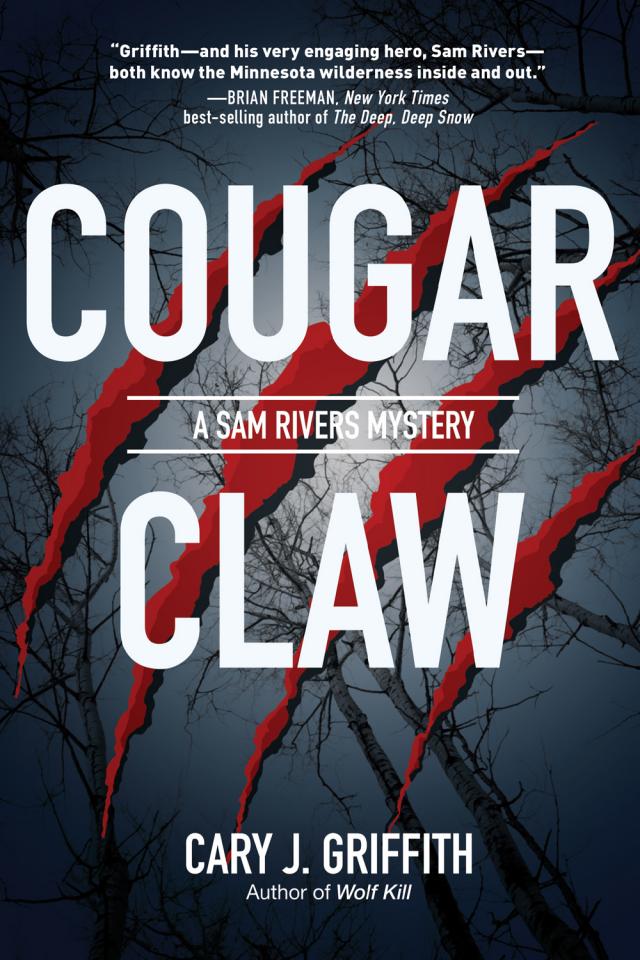
Cougar claw, p.1
Cougar Claw, page 1


Also by the author
Gunflint Burning: Fire in the Boundary Waters
Opening Goliath
Lost in the Wild
Wolf Kill
PRAISE FOR COUGAR CLAW
“In this highly anticipated second novel in the Sam Rivers series, Cary J. Griffith delivers another finely researched and compellingly written thriller. Both the beauty and the savagery of our natural world form the heart of a Griffith story. In this case, it’s the predatory habits of cougars. When the killing of a Twin Cities man in an apparent cougar attack brings Sam to the Minnesota River Valley to investigate, what follows is a gradual and fascinating revelation of not just the predatory nature of cougars, but that of humans as well.”
—William Kent Krueger, Edgar Award–winning author of
This Tender Land
“Griffith—and his very engaging hero, Sam Rivers—both know the Minnesota wilderness inside and out. But be careful. After staying up all night to devour Cougar Claw, you may find yourself listening for a low growl the next time you’re alone in the forest.”
—Brian Freeman, New York Times best-selling author of
The Deep, Deep Snow
“A deadly threat from the wild comes far too close for comfort when an urban bicyclist is found mauled to death by a cougar. In this second book in the Sam Rivers mystery series, Cary Griffith takes this U.S. Fish & Wildlife special agent on a hair-raising hunt to find the cougar—and the truth. Mixing deep knowledge of the natural world with the twists and turns of the best suspense novels, Cougar Claw is a thoughtful and thrilling story.”
—Mary Logue, author of the Claire Watkins mysteries and
The Streel
“Cougar Claw, the second installment in the Sam Rivers series, sends the U.S. Fish & Wildlife special agent to the scene of a grisly cougar killing on the outskirts of the Twin Cities. As usual in Sam Rivers’s world, all is not as it seems. Griffith doubles down on his strengths in this series, giving us another vibrant cast of allies, suspects, and a misunderstood predator, while navigating a path between animal rights and human fears of the natural world. I can’t wait for Sam Rivers’s next assignment.
—Mindy Mejia, author of Everything You Want Me To Be and
Strike Me Down
“From the first page to the last, Cougar Claw blends high suspense with the quiet observations of the predator’s predator, Sam Rivers. Between Griffith’s descriptions of Minnesota’s natural beauty and the human nature of his characters, this is a book you won’t want to end.”
—Debra H. Goldstein, award-winning author of the
Sarah Blair mystery series
Copy editors: Kate Johnson, Mary Logue, and Kerry Smith
Proofreader: Emily Beaumont
Cover design: Travis Bryant
Front cover photo: John McLaird/Shutterstock
Back cover photo: July Flower/Shutterstock
Library of Congress Cataloging-in-Publication Data
Names: Griffith, Cary J., author.
Title: Cougar claw : a Sam Rivers mystery / Cary J. Griffith.
Description: Cambridge, Minnesota : Adventure Publications, An imprint of AdventureKEEN, [2022]
Summary: “The sighting of a cougar in the Minnesota River Valley, outside the Twin Cities, is incredibly rare. A deadly cougar attack on a human in this area is about as likely as getting struck by lightning—twice. Yet when wealthy business owner Jack McGregor is found dead, the physical evidence seems incontrovertible. In Cougar Claw, natural history writer Cary J. Griffith brings back Sam Rivers, the predator’s predator, and pens a puzzling mystery filled with suspense and intrigue.” —Provided by publisher
Identifiers: LCCN 2021052057 (pbk.) | LCCN 2021052058 (ebook) | ISBN 9781647550813 (pbk.) | ISBN 9781647550806 (ebook)
Subjects: GSAFD: Mystery fiction. | Suspense fiction.
Classification: LCC PS3607.R54857 C68 2022 (print) | LCC PS3607.R54857 (ebook) | DDC 813/.6—dc23
LC record available at lccn.loc.gov/2021052057
LC ebook record available at ccn.loc.gov/2021052058
10 9 8 7 6 5 4 3 2 1
Copyright © 2022 by Cary J. Griffith
Cougar Claw: A Sam Rivers Mystery (book 2)
Published by Adventure Publications
An imprint of AdventureKEEN
310 Garfield Street South
Cambridge, MN 55008
(800) 678-7006
adventurepublications.net
All rights reserved
Printed in the USA
ISBN 978-1-64755-081-3 (pbk.); ISBN 978-1-64755-080-6 (ebook)
For Anna, life partner, playmate, and confidante
TABLE OF CONTENTS
PART 1
PROLOGUE
CHAPTER ONE
CHAPTER TWO
CHAPTER THREE
CHAPTER FOUR
CHAPTER FIVE
CHAPTER SIX
CHAPTER SEVEN
CHAPTER EIGHT
CHAPTER NINE
CHAPTER TEN
CHAPTER ELEVEN
CHAPTER TWELVE
CHAPTER THIRTEEN
PART II
CHAPTER FOURTEEN
CHAPTER FIFTEEN
CHAPTER SIXTEEN
CHAPTER SEVENTEEN
CHAPTER EIGHTEEN
CHAPTER NINETEEN
CHAPTER TWENTY
CHAPTER TWENTY-ONE
CHAPTER TWENTY-TWO
CHAPTER TWENTY-THREE
PART III
CHAPTER TWENTY-FOUR
CHAPTER TWENTY-FIVE
CHAPTER TWENTY-SIX
CHAPTER TWENTY-SEVEN
CHAPTER TWENTY-EIGHT
CHAPTER TWENTY-NINE
CHAPTER THIRTY
CHAPTER THIRTY-ONE
CHAPTER THIRTY-TWO
CHAPTER THIRTY-THREE
CHAPTER THIRTY-FOUR
CHAPTER THIRTY-FIVE
CHAPTER THIRTY-SIX
CHAPTER THIRTY-SEVEN
ACKNOWLEDGMENTS
ABOUT THE AUTHOR
DISCUSSION QUESTIONS
PART 1
PROLOGUE
September 2, Savage, Minnesota
Marlin Coots, McGregor Industries’ gap-toothed, splay-footed nighttime security watchman, was making his morning rounds at the company’s remote shipping facility. He loved this part of the day, when he could step to the edge of the minimum-maintenance road and gaze down into the Minnesota river-bottom woods. Sometimes he’d see a raccoon scurry into brambles, or an opossum’s slow climb up a tree. You never knew what the Savage woods would give up, which is why Marlin always took a moment to pause and look down.
The perimeter road was always empty, particularly here, where a huge oak anchored the landward side of the pair of dirt ruts. The other side of the road dropped 15 feet to the bottoms. On this morning, Marlin was startled to see a large brown animal lying on its side, its neck twisted at an unnatural angle.
A white-tailed deer. The kill was too primitive for a poacher.
Marlin backslid down the embankment. The carcass was barely cold. Its chest cavity had a clean incision from neck to belly. The ribs were parted and its heart and lungs were gone. When he looked around, he noticed a paw print the size of a fry pan.
“What the . . . ?”
His dad had told him there were serious predators in the Minnesota River Valley. Marlin’s father had spent most of his adult life hunting and fishing this wild stretch of river, from Mankato all the way up to Savage on the edge of the Twin Cities. Marlin didn’t share his dad’s enthusiasm for shooting game, but he loved seeing the animals in his neck of the woods. So he rigged a motion-activated game camera with an infrared flash, setting it up near the deer kill.
The next day, Marlin’s camera confirmed the presence of a cougar, one of the images clear enough to print. Since this part of the valley was considered an outlying Twin Cities suburb, the local media picked up the sighting. “Big Cat Returns to Minnesota,” the Star Tribune reported. One of the more dramatic TV news channels asked, “Are you safe in Minnesota’s woods?” The coverage reported that over the last 10 years, out West, there had been dozens of human–cougar encounters, “and in some instances people were stalked, killed, and eaten.”
The Minnesota Department of Natural Resources tried to place the sighting in perspective. Though cougar attacks were known to happen—even some in which humans were killed—in Minnesota people had a better chance of being struck by lightning.
The DNR suspected this cougar was someone’s rogue pet, though no one came forward. If it was wild, they surmised, it was extremely rare for Minnesota, with only a handful of confirmed sightings in the last 50 years, none near the Cities.
In any case, there was no need to worry. A big cat’s customary food source was deer, which could account for why this cougar had come to Savage. Along the suburban section of river, the white-tailed fattened on Kentucky bluegrass, backyard hostas, and tulip greens. Deer hunting was irregular or nonexistent, and the deer herd was prodigious.
The kill, the tracks, and the photo made for good TV, which is why, three days later, one station ran a follow-up piece on cougar hunting habits, noting they often returned to feed on kills a second, and even a third, time, sometimes several days later.
“So if you’re heading into the Minnesota River Valley,” warned the anchor, “be careful out there.”
CHAPTER ONE
September 23
Jack McGregor pumped hard through the bike’s lowest gear, his thighs burning. He neared the top of his quarter-mile climb, maintaining his bike’s progress up this last steep grade. The black coffee he had finished before 6 a.m. was finally taking hold. He glanced at his heart monitor and watched the numbers spike from 156 to 157. Sweat dampened his tight yellow bike shirt.
Twenty yards, he thought, which was about all he could manage, trying to keep his ragged breathing steady. He rabbit-pedaled through the last short rise and finally crested the hill.
He appreciated the quiet half hour before dawn when the world slept and the second-summer air hung still and pungent. His heart rate peaked at 164 and he managed a stiff grin.
He took in a long breath and smelled witch hazel, he guessed, the odor of weeds heavy with seedpods and a faint wisp of river more than a mile below. It was a wet metal smell. And maybe there was the trace of something fetid beneath it; a car-struck deer decaying in a ditch, or a snake flattened across the blacktop? Something. . .
Over the last couple days, Jack had felt uneasy. He assumed it was his pending business deal. But there was something else, the vague feeling he needed to be vigilant or wary or just plain cautious. And it was annoying because Jack McGregor, the 51-year-old owner, president, and chief executive officer of McGregor Industries, was a stranger to unease.
Chester Drive formed a T at the top of Wannamake Circle. The hill dropped down into Savage and the Minnesota River Valley, where it connected with Highway 13 more than a mile below. In another hour, the blacktop would be busy with morning commuters, emptying the exclusive neighborhoods up on the hill. But from Jack’s acme, at this time of morning, he had the road almost entirely to himself.
He turned onto Chester and crouched low, reducing his wind resistance so the air coming out of the valley wouldn’t pick him up like a sail. Not that there was much of a breeze a half hour before dawn. Jack liked to feel aerodynamic. He liked to travel fast. As his bike picked up speed, he put his nagging doubts behind him and peered ahead, grinning down the dark thoroughfare.
Jack’s Cannondale RZ One Forty mountain bike had been a 51st-birthday present. Carla accused him of a midlife crisis before finally accepting and then indulging his effort to stay fit. She bought him the most expensive bike she could find, making a big deal about its carbon alloy frame and phenomenal suspension. And no doubt about it, the bike could fly. His best birthday present came later that evening.
Carla was 37, and a mix of fortuitous genes, hard exercise, and no children kept her in the kind of shape Jack liked to see and feel in a woman. And the seasoning she’d experienced through her 20s, when she’d married one creep and then another, helped cultivate a particular appreciation for Jack.
The speedometer hit 22. He looked up and saw the road empty all the way to 13, not a car in sight. When he glanced down again, the speedometer read 25.
It was still too early for predawn light, which was why Jack squinted down the path in front of him. At this speed, traveling near the tree edge, it was foolhardy to look anywhere but directly in front of you. Deer frequented the wilder parts of Chester Hill. And plenty of nocturnal animals chose this final hour of darkness to hunt for a safe place to bed down and sleep for the day. Or to search for one last unsuspecting prey.
The wild country was one of the features that had charmed Jack and Carla about Savage. They could have chosen a big house in Edina, Excelsior, Shorewood, or just about any other place they wanted. But Carla liked the unpretentiousness of Savage. She appreciated the secluded, country feel of Wannamake Circle and their remote cul-de-sac, where she wouldn’t run into anyone from the Club and where she could buy milk at the local Cub grocery without having to dress up or put on.
Speedometer: 27.
Up ahead something stirred. Under a sumac patch. Not a deer; the movement was too furtive and close to the ground. At his current speed, he would hit it head-on in a matter of seconds.
Jack yelled, the dark creature froze, and Jack hurtled by in a blast. He glimpsed a skunk hunkered down in the grass.
Just a few seconds either way, rodent or man, and Jack might have been a stinking pile of . . .
Focus on the tree edge, he reminded himself. It was a brief part of the hill, and he watched as its shadows flew by and opened onto empty pasture. His near brush with calamity rocketed his pulse. His bike speed climbed to 33. He glanced in front of him. The pools of light from the gentrified streetlamps were clear all the way to the bottom, and Jack flew.
The white Ford Focus—a rental out of Brooklyn Center—approached the entrance to the dirt road.
“Here’s the turn,” Benedict said.
“I know,” John said, tired of taking orders.
They wore dark camo, head to foot. John wore a camo baseball hat with CABELA’s emblazoned above the bill. Benedict wore a bucket hat. They were edgy in the predawn.
John did what he often did, knowing there was bad business ahead. He put himself past it. In 2 hours, I will be back at my place . . . showering . . . getting ready for work. Just another day.
But given the task ahead, focusing on what came after was difficult.
This stretch of Highway 13 was mostly open country, separated by occasional remote storage facilities and grain elevators. Farther north, Savage gave way to Burnsville and single-family homes, apartment complexes, and a string of busy retail outlets crowding either side of the highway all the way to Interstate 35W. Travel south and you passed more open country until the Valley Fair Amusement Park and Shakopee, the next suburb over. But here, in between the park and Burnsville’s stores, the river bottom was vacant and wild, except for McGregor Industries and its potash and fertilizer facility.
John glanced in his rearview mirror. He saw one pair of headlights, a quarter mile behind him. At this hour, there was nothing up ahead. He signaled, turning onto the narrow dirt lane. It was empty and dark and rose to a pair of unmarked railroad tracks. On either side, the weeds were high and overgrown, and the car rumbled over the rails, leaving a faint cloud of dust. The car dropped over the hill and John turned onto the frontage road, pulled over beside a stand of river maples, and cut the engine. The headlights darkened.
They each glanced at their watches. They would sit in the car for exactly 5 minutes, waiting for the dust to settle and the crickets’ screedle-screedle to return in the dark.
The first time John met Benedict was a week ago Saturday at the Black Angus truck stop on 169 outside Mankato. That was before any of them had names.
John thought driving 60 miles south when they could have met anywhere in the Twin Cities was a stupid precaution. He’d entered the truck stop, glanced at the handful of customers, and recognized Benedict as the guy sitting at the end of the counter, sipping coffee.
Benedict said he would be dressed in green khaki camo, like others in the diner—a hunter getting a jump on the grouse season. He wore his hat and dark aviator sunglasses and a bristly mustache John guessed was fake, but a good fake. His hair was loose and wild under his hat. John thought it, too, might be fake, but he wasn’t sure.
John sidled up to the nondescript counter, keeping a seat between them. He was hungry for eggs, hash browns, and buttered toast with maybe a side of medium-hot salsa and some extra bacon. His normal custom would be to slip into some easy conversation, probably talking about the best-looking woman in the café, though this morning the selection was poor.
Benedict stared straight ahead into the mirror behind the counter. “You’re late,” he whispered, harsh.
A waitress approached.
“Coffee?” she asked.
“Why, thank you . . . Nancy,” John said, reading her name tag and flashing a smile. John had perfect teeth. His brown hair was short and carefully trimmed. He wore slick warm-ups and black tennis shoes that marked him as not from around here and not interested in fitting in. An old girlfriend once called him smarmy. After he looked it up, it ticked him off because it was true.
Nancy smiled and poured his coffee. “Hey, sugar.”
He had that effect on women of a certain kind. Normally he would have told her his real name, which wasn’t John. But the man sitting one stool over was making him edgy.
She passed him a menu and shoved off to fill more cups.
“Now get this,” Benedict whispered. “Next time you’re late, the deal’s off. I call the shots, and if you don’t like them, you know what you can do about it. Understood?” This was all said through lips that barely moved, staring into his coffee cup.






