

Golden days, p.1
Golden Days, page 1
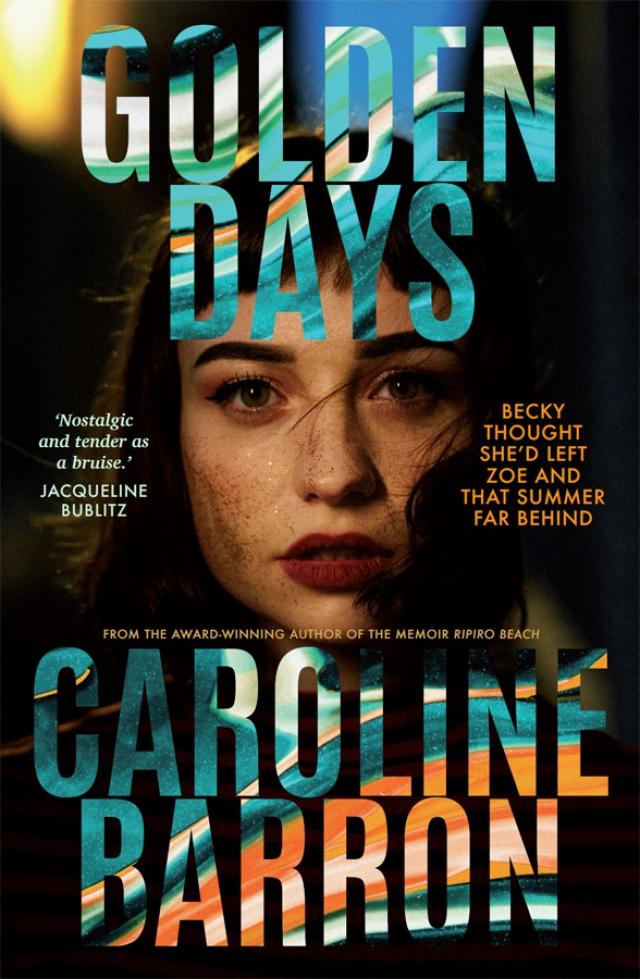


© Dean Cornish
Caroline Barron (Te Uri o Hau, Pākehā) is an award-winning author, manuscript assessor and book coach, book reviewer and writing teacher. Her memoir Ripiro Beach won the New Zealand Heritage Literary Award for Best Non-fiction Book in 2020. She holds a Master’s in Creative Writing from the University of Auckland plus a journalism degree and, in a previous life, owned and ran Nova – a leading model and talent agency. Caroline resides between Auckland and Northland’s Ripiro (Baylys) Beach, with her husband and two daughters. Golden Days is her first work of fiction.
First published by Affirm Press in 2023
Boon Wurrung Country
28 Thistlethwaite Street,
South Melbourne, VIC 3205
affirmpress.com.au
Text copyright © Caroline Barron, 2023
All rights reserved. No part of this publication may be reproduced without prior written permission from the publisher.
Every effort has been made to trace copyright holders and to obtain their permission for the use of copyright material. The publisher apologises for any errors or omissions and would be grateful if notified of any corrections that should be incorporated in future editions and reprints of this book.
Extract from TS Eliot’s ‘The Waste Land’ reproduced with permission of Faber & Faber UK.
This is a work of fiction. Unless otherwise indicated, all the names, characters, businesses, places, events and incidents in this book are either the product of the author’s imagination or used in a fictitious manner. Any resemblance to actual persons, living or dead, or actual events is purely coincidental.
ISBN: 9781922848383 (paperback)
Cover design by Andy Warren © Affirm Press Front-cover image © Javier Díez/Stocksy United
For Deyna and Jean
The best mirror is an old friend.
George Herbert
PART I
The best and worst friend I ever had was Zoe Golden.
There’s this image of her that keeps infiltrating my mind, looping around my brain, faster and faster, like someone’s turned up the volume and the colour, and she’s right there in front of me: a close-up of her laughing – her unbounded, irresistible laugh tumbling out – and in her hand is a sketchbook bulging with glued-in layers. I can’t figure out why she’s back – why at this time, in all my grief and confusion over Jono and our marriage, she’s in my head again. So I do the only thing that turns off all that colour and sound and laughter: I pour another drink.
The weeks since Jono’s heart attack seem to have evaporated, leaving only brittle salt-crystal memories that disintegrate when I try to recall a minute. An hour. A week. All I know is that at the end of that awful day, I closed the blinds, disconnected the gate buzzer and climbed into bed. I don’t read, I can’t, instead staring at true crime and reality TV shows on my laptop, earbuds in, episodes sliding one after another through my consciousness. At one stage, I watched six episodes in a row of an awful fly-on-the-wall show called Intervention, bearing witness to the hideous free-fall of mostly women addicted to booze, methamphetamine, sex. There’s a young mother I can’t stop thinking about – she hadn’t swallowed food or liquid in twelve years, instead feeding herself with a giant syringe through a tube in her stomach. I look at the glass on my bedside table, slug the last centimetre of straw-coloured wine, and make myself not look at the empty bottle I dropped onto the carpet.
In all this yearning stillness, I can imagine what that tube-woman was going through. I close my eyes and consider the convenience of a giant plastic syringe. Huh, imagine that, not even having to leave your bed to eat. Not even having to chew.
My mobile has been ringing and ringing – well-meaning friends, some I hadn’t heard from in years, wanting to dip their toe into my drama. Mum, then Dad, calling over and over. I almost answered when Dad’s number flashed up this morning, needing to hear his voice – wanting him to launch into one of his spiels, to assure me it’s going to be okay and that this will look different when lodged into its broader historical context in years to come. But it’s too soon for that. I didn’t pick up. I just sighed and slid my phone under the pillow.
Now and then, my mind strays back to Jono and me. Like in a memory palace, I look left and right, see the ornaments of the life we built. There is the dappled pomegranate vase Meg and Nick gave us for a wedding present. There, dangling on the key hanger out in the hallway by the front door, are the keys to the Piha house I’ve been unable to think about since that day. I loved that key hanger, you know. Jono made it for my birthday the year we got together, and it travelled from house to house: from the tiny Grey Lynn flat to the three-bedroom in Ellerslie, and then to this modern four-bedder in Parnell. Plain blond ply, unvarnished, four simple brass hooks. It felt like a statement of sorts, a declaration of how we’d wanted our life to be. I press closed my laptop, shut away those stupid shows. Breathe out. Ignore how revolting my sheets smell.
It turns out our life wasn’t enough. The more years that passed – the more franchised stores we rolled out across the North Island, and the more income that came gushing in – the less those brass hooks fit our home or life. Until one day I looked at myself in the mirror of our enormous brand-new bathroom – complete with American oak double vanity and gleaming marble floor – and didn’t know who the hell I was.
~
It was a crisp autumn day three weeks ago when it happened. I’d had a busy morning – the winter catalogue was due to go to print but had been delayed by an overseas supplier’s nonchalance over meeting a copy-approval deadline. For a moment, my mind zips back to my office, with its view of the steel-skeletoned Harbour Bridge, sharpened pencils in the eggshell blue mug I’d bought at the Matakana Market and pages of copy lined up on my desk ready for a final once-over.
I’d decided a few years earlier it was time to step away from the family plumbing business and have something of my own. After six months of depressing toil attempting to resurrect the poems I’d written at university and transform them into a novel, I’d taken a full-time copywriting job at – as the ad proudly stated – Australasia’s largest fashion and apparel omnichannel catalogue retailer. Just to get back in the writing zone, I told myself.
I soon realised you had to be careful what you wished for. Inject some luxe in your life with this refined essential is one of my recent masterpieces. A boat neck cashmere sweater in a classic relaxed fit. Perfect for a romantic weekend away. In reality, each day stripped away a tiny piece of my soul.
Years ago, my creative writing paper tutor told the class that if we wanted to be writers, we should get jobs in completely unrelated fields that would earn us money and expose us to potential stories. I’d scoffed when he suggested being a postie or working in retail. A university degree for that? After graduating, I spent a couple of years at the Central Leader churning out flavourless copy about garden shows, local board meetings and school fairs. Then, once Jono and I married, I’d spent almost seven years working with him at Calibrate Plumbing and Gas, wrangling franchisees and their endless marketing and branding misunderstandings, clarifying contract terms and checking signage files. And still no stories to show.
Lying here in bed, I feel it in my bones. Not only do I no longer have a husband, but I have made the wrong decisions over and over again. How could everything I believed have been a lie?
Anyway, it was that day, three weeks ago, that my mobile rang. It was Carrie, Calibrate’s head office manager. What’s Jono forgotten? I often joked to my best friend Meg that Carrie was his work wife, phoning me if he’d left his mobile at home or if he had to work late. Carrie was one of those pretty, clear-skinned, no-makeup women – the type who spent her weekends hiking Rangitoto, not drinking wine and eating sliders with friends around the kitchen island like me. Carrie was sweet. Harmless. I liked and appreciated her. I was always chatty, although my friendliness never extended to a dinner invite. I picked up the phone.
‘Hi, Carrie, what’s up?’ I kept typing: … night sky denim with a touch of elastane to stretch with your body …
Sobbing.
I stopped. Sat up. ‘Carrie? What is it?’
Ragged breath. ‘Becky, I’m sorry …’
‘For fuck’s sake, Carrie, tell me what’s happened!’
‘It’s Jono,’ she said.
My heart plunged into my stomach.
‘What? What’s happened?’ I said. My mind tore around, clutching for pieces of reality. It was Tuesday afternoon, wasn’t it? He’d be at the gym.
‘He’s had a heart attack,’ stuttered Carrie.
‘What the hell?’ I grabbed my handbag and keys. ‘Tell him I’m on my way. It’s only ten minutes to the gym from here.’
Something kept me on the line.
‘No, not the gym,’ she said, her voice shaking. ‘They’ve taken him in an ambulance to the hospital.’
‘Hospital?’ None of it made any sense. ‘What hospital?’
Silence, a whimpering breath.
‘Fuck! Carrie!’
‘I’m sorry,’ she whispered.
It was at that moment, I think, looking back, that I knew life would, once again, be changed forever.
‘Sorry for what?’ I said, gripping the edge of my desk.
Around me, the entire office had ground to a halt – fingers paused on keyboards, phones pressed against ears. Somewhere, a photocopier spluttered out pages.
‘He wasn’t at the gym,’ she said. ‘We were at Piha. He was with me.’
~
My heart was incine rated that day. I keep imagining the singed edges of it, ragged and blistered. That was why I ached so much inside. Every relentless beat of it pulsed pain through my body: you knew, ba-dum, you knew, ba-dum.
Jono was discharged from hospital a few days ago. He knew better than to try to come home, instead recovering at his parents’ place on the North Shore. Any day, I know he’ll regain his strength enough to phone me. But I’m frozen. I simply cannot have that conversation yet. I will not pick up his call either.
My eyes slide down to the bottle on the floor. With a grunt, I roll out of bed, joints stiff, and make my way to the kitchen. I yank open the fridge and then slam it shut. I make my way into the lounge and crouch down in front of the mirror-fronted cocktail cabinet I bought Jono for his birthday a few years ago and packed with spirits and stainless-steel accoutrements at colossal expense. We spent summer weekends mixing cocktails – margaritas and watermelon daiquiris, mojitos and Negronis. We sat on the deck and drank as the sun sank lower in the sky. Had they been good times? My mind flicks to the awful night of the 42s – four shots of Stoli in a tall glass over ice topped with fresh lime. Jono’s face.
I sink onto the carpet and open the cupboard, but not before catching my reflection in its mirrored surface. Dear god. My skin is even paler than usual, my freckles a haphazard splatter. Even worse than the purple pouches beneath my eyes is that I can smell myself: the musky sebum of unwashed hair and the tart note of underwear that needs changing.
My skin feels dry and dusty but crevasse-sticky, all at once.
I take out the bottle of Stoli and push to my feet. Back in the kitchen, I fill a tall glass with ice, glug in four or so shots, top it with lime cordial and scull the lot. Cheers, Zoe. I immediately berate myself because that woman doesn’t belong in my head. Not now. The alcohol ricochets off my stomach and seeps into my bloodstream, dousing my heart’s smoking rim and loosening my brain. I pour the same again, scull it and then leave the glass in the sink before slinking back to bed. As I pull the covers over my head, my laptop bumps against my back, its hard corner poking my spine. Hah, spooned by none other than my MacBook Pro.
The alcohol has unbound my clenched-fist mind and thoughts begin to make their way in, incessantly flashing photographs of moments. The first is from the hospital: Carrie, red-eyed and dishevelled, flanked by two of Jono’s staff – my old workmates, friends we’d had around the dinner table time and time again. The sickly jolt of realisation that they all knew.
The images are getting muddled but a memory of Zoe fights its way through. It was the second time I’d ever seen her, and only hours after our eyes had met for the first time outside my house. Her small frame had appeared in the doorway of the lecture theatre, and there was a pack of whiteboard markers in her hand. Her nude-pencilled lips curved into a smile as she scanned the class, her eyes landing on me again. It was as though she’d sought me out. Stared me down. Deciding whether I fit.
My mind fast-forwards, dragging inevitably to that last night of our friendship, and all of a sudden everything becomes a clanging discord, a jumble of notes from the same song: the night when Zoe annihilated everything, and the phone call from Carrie. As if not seventeen years, as if not a single day, has passed between the first and the second. I shake the images away. My heart pounds so fast I feel it in my throat and stomach, and my mind is a riot of colour and noise. I cannot bear it. Zoe has no right to show up inside my head again like this.
~
The world cracked open the summer of 1995–1996 – when Meg and I were nineteen and Zoe was twenty – spilling its brilliant treasure into our lives. God, it was glorious. When I think of it now, I see a second or two of grainy film of Zoe, Meg and me. We’re pushing up off our towels and sprinting down the blazing Piha sand to the ocean – for the surf was so crashingly massive that it could not merely be called the sea – soothing our singed feet in the foamy shallows. Meg is the tallest and curviest of the three of us. I’m the pale-but-interesting skinny one. And Zoe? Well, Zoe is the size of a child but somehow more woman than any of us.
Even in those few seconds of film, it’s obvious that the spotlight somehow pools on Zoe – the thing, perhaps, I loved most about her. Meg and I are still in the frame, although it seems whenever I play the film, I’m always a step or two ahead of Meg and always downwind from Zoe. We wade into the water next to her, basking in her dazzling light. Love me, the light glimmered. Be loved by me.
But I didn’t understand then why Zoe was the way she was, because when you’re nineteen life is all about you. Or maybe that’s just me. When I look back, it feels as if I didn’t have the capacity to see my friends within the context of their upbringing and life. I thought I had a grip on things, that I knew Zoe, but really, I had no clue. I couldn’t see the inverse effect of her attracting all that light. The way she drained the energy out of the room. For the attraction between magnets is always a little greater than the repulsion.
I also keep returning to the summer before that, heading into ’95 – how excited Meg and I were to be starting uni that February and how tied up in knots I was about breaking up with Michael after two years. All of that created a vacuum in my life. I knew it was there;
I could feel it, ached with the emptiness of it. I filled it, and the summer, with working as many shifts as I could selling clothes at Three Bears in Newmarket and reading. That summer, I read more than I ever had before, falling in love with the new breed of authors unapologetically writing their unique worlds: Ben Okri and Irvine Welsh, Jung Chang and Sebastian Faulks. After a time, though, rather than acting as a salve, the stories created even more space inside of me until I felt cave-like and echoey. My life wasn’t unapologetic or brave or tinted with magic. My life was just my life. Even, it turned out, uni wasn’t quite what Meg and I had expected.
We were eighteen when we began our communications degree that year. Our curious natures and love for writing stories were funnelled into this one course that seemed to glow with the hope of a new and exciting life. For a time, I’d tossed up whether to do music or comms, but eventually decided my (average) guitar playing was best left as a bedroom hobby. Meg and I would bus into town together from our adjacent tree-lined cul-de-sacs, so early that sometimes we’d fall asleep against each other’s shoulder or the window.
After my last year at school, I’d expected university to be something other than it was, which was a bunch of bright suburban kids riding the wave of their parents’ expectations. And yet there was a tension in those lecture theatres: a rubbing up of reality against potentiality. The lectures on communication, sociology, film and TV, and politics and writing, levered open our skulls and hearts, making us yearn for a life that was more … well, more than what it was. We had the theory, but we didn’t know how to translate it into real life, especially here in this tiny, nuggety country at the bottom of the world. I wanted to chase war around the globe like Martha Gellhorn or road trip like Hunter S Thompson. Instead, I was yelling out the lyrics to ‘Zombie’ by the Cranberries, figuring out the chords to Lenny Kravitz songs and writing awful Sylvia Plath-inspired poetry in my middle-class Epsom bedroom.
By the second semester, we’d settled in – absorbed into a small group who spent lunchtimes smoking cigarettes, discussing literature and drinking endless refills of filter coffee at Robert Harris on Queen Street. It wasn’t trendy; it was where clutches of old ladies nibbled club sandwiches, with the sound of teaspoons tinkling on saucers, butter cubes wrapped in twists of baking paper, heavy silver knives scraping across the crumbly surfaces of date scones. Come to think of it, it was an odd choice. I wonder why we didn’t pick one of the dark cafes on Vulcan Lane, like Rupin, packed with bright young things at the centre of it all. I guess we felt at home at the top of the escalators in the vast, light space, a step removed from the fashionable expectations of High Street.
That’s how we met Pete. One day, he tagged along with Meg and me down Queen Street to the cafe and that was that. On the weekends, it was mostly Meg and me, with Pete sometimes joining us. But he was running two lives, not quite sure yet if he was ready to declare himself to the world. Or at least who he could show his orthopaedic-surgeon father he was going to be. New Zealand might have been the first country in the world to decriminalise homosexual sex in 1986 because of AIDS, but that didn’t make it any easier in 1995 for a son to tell a father he was gay. Pete simply accepted that if he told his dad, they would no longer go duck shooting together in the first week of May each year, that his father would withdraw the petrol card, and no longer pay his uni fees.






