Abandon a novel, p.1
Abandon: A Novel, page 1


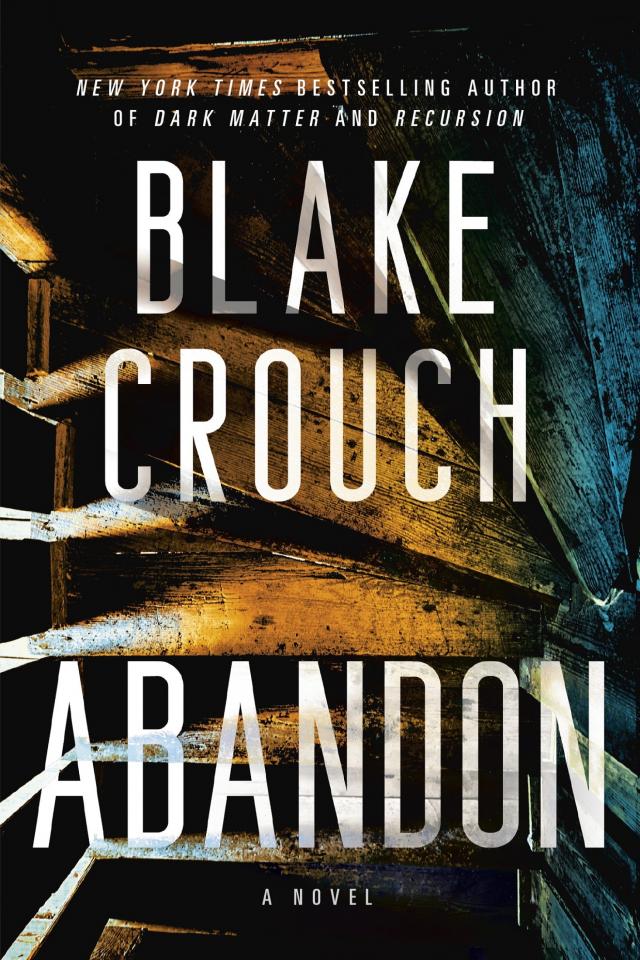
Abandon is a work of fiction. Names, characters, places, and incidents are the products of the author’s imagination or are used fictitiously. Any resemblance to actual events, locales, or persons, living or dead, is entirely coincidental.
Copyright © 2009 by Blake Crouch
On the Good, Red Road by Blake Crouch copyright © 2010 by Blake Crouch
All rights reserved.
Published in the United States by Ballantine Books, an imprint of Random House, a division of Penguin Random House LLC, New York.
Ballantine is a registered trademark and the colophon is a trademark of Penguin Random House LLC.
Originally published in the United States by Minotour Books, New York, in 2009.
“On the Good, Red Road” first appeared in the Brilliance Audio edition of Abandon by Blake Crouch.
ISBN 9780593598528
Ebook ISBN 9780593598535
randomhousebooks.com
Book design by Alexis Capitini, adapted for ebook
Cover design: Tal Goretsky/Scott Biel
Cover image: iStock / Getty Images Plus
ep_prh_6.0_142203063_c0_r0
Contents
Cover
Title Page
Copyright
Epigraph
Thursday, December 28, 1893
Present Day
Chapter 1
Chapter 2
Chapter 3
Chapter 4
Chapter 5
Chapter 6
1893
Chapter 7
Chapter 8
Chapter 9
Chapter 10
Chapter 11
Present Day
Chapter 12
Chapter 13
Chapter 14
Chapter 15
Chapter 16
1893
Chapter 17
Chapter 18
Chapter 19
Chapter 20
Chapter 21
Present Day
Chapter 22
Chapter 23
Chapter 24
Chapter 25
Chapter 26
Chapter 27
1893
Chapter 28
Chapter 29
Chapter 30
Chapter 31
Chapter 32
Chapter 33
Chapter 34
Present Day
Chapter 35
Chapter 36
Chapter 37
Chapter 38
Chapter 39
Chapter 40
Chapter 41
1893
Chapter 42
Chapter 43
Present Day
Chapter 44
Chapter 45
Chapter 46
1893
Chapter 47
Chapter 48
Present Day
Chapter 49
Chapter 50
Chapter 51
1893
Chapter 52
Present Day
Chapter 53
1893
Chapter 54
Present Day
Chapter 55
1893
Chapter 56
Present Day
Chapter 57
1893
Chapter 58
Chapter 59
Present Day
Chapter 60
1893
Chapter 61
Present Day
Chapter 62
Chapter 63
Chapter 64
1893
Chapter 65
Chapter 66
Chapter 67
Chapter 68
Present Day
Chapter 69
Chapter 70
Chapter 71
1893
Chapter 72
Chapter 73
Chapter 74
Present Day
Chapter 75
Chapter 76
Chapter 77
Chapter 78
1893
Chapter 79
Chapter 80
Present Day
Chapter 81
1893
Chapter 82
Chapter 83
Present Day
Chapter 84
1893
Chapter 85
Present Day
Chapter 86
Chapter 87
Chapter 88
Chapter 89
Chapter 90
1893
Chapter 91
Present Day
Chapter 92
Author's Note
Dedication
Acknowledgments
Short Story: On the Good, Red Road
By Blake Crouch
About the Author
In the West, the past is very close. In many places, it still believes it’s the present.
—John Masters
THURSDAY, DECEMBER 28, 1893
Wind rips through the crags a thousand feet above, nothing moving in this godforsaken town, and the mule skinner knows that something is wrong. Two miles south stands Bartholomew Packer’s mine, the Godsend, a twenty-stamp mill that should be filling this box canyon with the thudding racket of the rock crushers pulverizing ore. The sound of the stamps in operation is the sound of money being made, and only two things will stop them—Christmas and tragedy.
He dismounts his albino steed, the horse’s pinked nostrils flaring, dirty mane matted with ice. The single-rig saddle is snow-crusted as well, its leather and cloth components—the mochila and shabrack—frozen stiff. He rubs George’s neck, speaking in soft, low tones he knows will calm the animal, telling him he did a good day’s work and that a warm stable awaits with feed and fresh water.
The mule skinner opens his wallet, collects the pint of busthead he bought at a bodega in Silverton, and swallows the remaining mouthful, whiskey crashing into his empty stomach like iced fire.
He wades through waist-deep snow to the mercantile, bangs his shop-mades on the door frame. Inside, the lamps have been extinguished and the big stove squats dormant in the corner, unattended by the usual constellation of miners jawboning over coffee and tobacco. He calls for the owner as he crosses the board floor, moving between shelves, past stacked crates and burlap sacks bulging with sugar and flour.
“Jessup? It’s Brady! You in back?”
No one answers.
The twelve burros crane their scrawny necks in his direction when Brady emerges from the merc. He reaches into his greatcoat, pulls out a tin of Star Navy tobacco, and shoves a chaw between lips and gums gone blackish purple in the last year.
“What the hell?” he whispers.
When he delivered supplies two weeks ago, this little mining town was bustling. Now Abandon looms listless before him in the gloom of late afternoon, streets empty, snow banked high against the unshoveled plank sidewalks, no tracks as far as he can see.
The cabins scattered across the lower slopes lie buried to their chimneys, and with not a one of them smoking, the air smells too clean.
Brady is a man at home in solitude, often spending days on the trail, alone in wild, quiet places, but this silence is all wrong—a lie. He feels menaced by it, and with each passing moment, more certain that something has happened here.
A wall of dark clouds scrapes over the peaks, and snowflakes begin to speck the sleeves of his slicker. Here comes the wind. Chimes clang over the doorway of the merc. It will be night soon.
He makes his way up the street into the saloon, still half-expecting Joss Maddox, the striking barkeep, to assault him with some gloriously profane greeting. No one’s there. Not the mute piano player, not a single customer, and again, no light from the kerosene lamps, no warmth from the potbellied stove, just a half-filled glass on the pine bar, the beer frozen through.
The path to the nearest cabin lies beneath untrodden snow, and without webs, it takes five minutes to cover a hundred yards.
He pounds his gloved fist against the door. No one answers. The latch string hasn’t been pulled in, and despite the circumstance, he still feels like a trespasser as he steps inside uninvited.
In the dark, his eyes strain to adjust.
Around the base of a potted spruce tree, crumpled pages of newspaper clutter the dirt floor—remnants of Christmas.
Food languishes untouched on a rustic table, far too lavish to be any ordinary meal for the occupants of this cramped one-room cabin. This was Christmas dinner.
He removes a glove, touches the ham—cold and hard as ore. A pot sits there, the beans frozen in their br oth. The cake feels more like pumice than sponge, and two jagged glass stems still stand upright, the wine having frozen and shattered the crystal cups.
* * *
Outside again, back with his pack train, he shouts, turning slowly in the middle of the street so the words carry in all directions.
“Anyone here?”
His voice and the fading echo of it sound so small rising against the vast, indifferent sweep of wilderness. The sky dims. Snow falls harder. The church at the north end of town disappears in the storm.
It’s twenty-seven miles back to Silverton, and the pack train has been on the trail since before first light. The burros need rest. Having driven mules the last sixteen hours, he needs it, too, though the prospect of spending the night in Abandon, in this awful silence, unnerves him.
As he slips a boot into the stirrup, ready to take the burros down to the stables, he notices something beyond the cribs at the south end of town. He urges George forward, trots through deep powder between the false-fronted buildings, and when he sees what caught his eye, he whispers, “You old fool.”
Just a snowman scowling at him, spindly arms made of spruce branches, pinecones for teeth and eyes, garland for a crown.
He tugs the reins, turning George back toward town, and the jolt of seeing her provokes, “Lord God Amighty.”
He drops his head, tries to allay the thumping of his heart in the thin air. When he looks up again, the young girl is still there, perhaps six or seven, apparition-pale and just ten feet away, with locomotive-black curls and coal eyes to match—so dark and with such scant delineation between iris and pupil, they more resemble wet stones.
“You put a fright in me,” he says. “What are you doin out here all alone?”
She backpedals.
“Don’t be scart. I ain’t the bogeyman.” Brady alights, wades toward her through the snow. With the young girl in webs sunk only a foot in powder, and the mule skinner to his waist, he thinks it odd to stand eye-to-eye with a child.
“You all right?” he asks. “I didn’t think there was nobody here.” The snowflakes stand out like white confetti in the child’s hair.
“They’re all gone,” she says, no emotion, no tears, just an unaffected statement of fact.
“Even your ma and pa?” She nods.
“Where’d they all go to? Can you show me?”
She takes another step back, reaches into her gray woolen cloak. The single-action army revolver is a heavy sidearm, and it sags comically in the child’s hand, so she holds it like a rifle. Brady is too surprised to do a thing but watch as she struggles with the hammer.
“Okay, I’ll show you,” she says, the hammer locked back, sighting him up, her small finger already in the trigger guard.
“Now hold on. Wait just a—”
“Stay still.”
“That ain’t no toy to point in someone’s direction. It’s for—”
“Killin. I know. You’ll feel better directly.”
As Brady scrambles for a way to rib up this young girl to hand him the gun, he hears its report ricocheting through the canyon, finds himself lying on his back, surrounded by a wall of snow.
In the oval of gray winter sky, the child’s face appears, looking down at him.
What in God’s—
“It made a hole in your neck.”
He attempts to tell her to stable George and the burros, see that they’re fed and watered. After all the work they put in today, they deserve at least that. Only gurgles emerge, and when he tries to breathe, his throat whistles.
She points the revolver at his face again, one eye closed, the barrel slightly quivering, a parody of aiming.
He stares up into the deluge of snowflakes, the sky already immersed in a bluish dusk that seems to deepen before his eyes, and he wonders, Is the day really fading that fast, or am I?
PRESENT DAY
CHAPTER 1
Abigail Foster stared through the windshield at the expired parking meter. Her fingers strangled the steering wheel, knuckles blanching, hands beginning to cramp. This had all seemed like such a good idea a month ago back in New York when she’d pitched the article to Margot, her editor at Great Outdoors. Now, on the verge of seeing him for the first time in twenty-six years, she realized she’d done herself the disservice of glossing over this moment and the fact that she’d have to walk into that building and face him.
Her watch showed five minutes to seven, which meant it was five to five, Mountain Time. She’d sat in this parking space for twenty minutes, and he was probably about to leave, thinking she’d decided not to come. The hostess showed her toward the back of the brewpub, which at five in the afternoon stood mostly empty. Peanut shells littered the floor, crunching beneath the heels of her black pumps, and the reek of brewing beer infused the air with a yeasty sourness. The hostess held the back door open and motioned to the only occupied table on the patio.
Abigail stepped outside, smoothed the Cavalli skirt she’d paid way too much for last year in Milan.
The doubt resurfaced. She shouldn’t have come. No story was worth this.
He sat alone with his back to her at a west-facing table, with the town of Durango, Colorado, spread out before him in its high valley, specked with the bright yellows of cottonwood and aspen, enclosed by pine-wooded hills and bare shale hills and, farther back, the spruce forests and jagged peaks of the San Juans.
The sound of the patio door banging shut caught his attention. He looked over his shoulder, and at the sight of her, slid his chair back from the table and stood—tall, sturdy, wavy silver hair, dark blues, and dressed like something out of Backpacker magazine—plaid Patagonia button-up shirt tucked into a comfortable pair of jeans, Teva sandals.
She felt that knot constricting in her stomach again, noticed his left hand trembling. He seized the chair he’d been sitting in to steady it.
“Hi, Lawrence.”
She knew he was fifty-two, but he’d aged even better than his photo on the history department’s website indicated.
No handshake, no hug, just five seconds of what Abigail ranked as the most excruciating eye contact she’d ever held.
Easing down into a chair, she counted three empty pints on the table, wished she’d had the benefit of alcohol to steel herself for this meeting.
She rifled through her purse, found her sunglasses. It was Halloween, and though the air carried a chill, at this elevation the intensity of direct sunlight made it pleasant to sit outdoors.
“I’m glad you came,” Lawrence said.
A waiter costumed as a hula dancer approached the table.
“Want a beer, Abigail?” Lawrence asked.